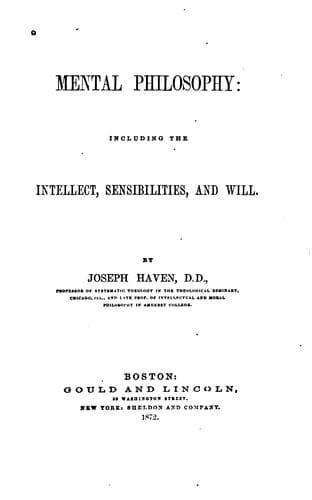
Mental Philosophy: Including the Intellect, Sensibilities, and WillHaven, Joseph
Philosophy
Mental Philosophy: Including the Intellect, Sensibilities, and Will
Haven, Joseph
Psychology
_Different applications of the Term._--Evidently, then, the word has
somewhat different senses as applied to different classes of objects,
whose individuality or essence varies. There are three distinct classes
of objects to which the term is applicable. 1. Spiritual existence. 2.
Organic and animate material existence. 3. Inorganic matter.
_As applied to the first Class._--As regards the first class,
_spiritual existences_, their identity consists in simple oneness and
continuity of existence. It is enough that the soul or spirit exist,
and continue to exist. So long as this is the case, identity is
predicable of it. Should that existence cease, the identity ceases,
since the object no longer exists of which identity can be affirmed.
Should another spirit be created in its place, and even, _if the thing
be supposable_, should it be endowed, not only with the same qualities,
but the same _consciousness_, so as to be conscious of all that of
which the former was conscious, still it would not be identical with
the former. It is, by the very supposition, _another_ spirit, and not
the same. To be identical with it, it must be the very same essence,
being, or existence, and not some other in its place.
It is only of spiritual immaterial existence that identity, in its
strict and complete sense, is properly predicable, since it is only
this class of existences that retains, unimpaired, its simple oneness,
sameness, continuity of essence.
_Personal Identity._--When we speak of _personal_ identity, we mean
that of the spirit, the soul, the ego, in distinction from the
corporeal material part. The _evidence_ of personal identity is
_consciousness_. We know that the thinking conscious existence of
to-day, which we call _self_, _me_, is one and the same with the
thinking conscious self or me of yesterday, and not some other personal
existence of like attributes and condition.
Public-domain text, read in full here on John Shaqi.
Reviews
Reviews
No reviews yet
Be the first to share your thoughts on this work.
Elsewhere in the archive
Join the Discussion
Join the discussion
Sign in to leave a comment or review.
Sign InorCreate an account