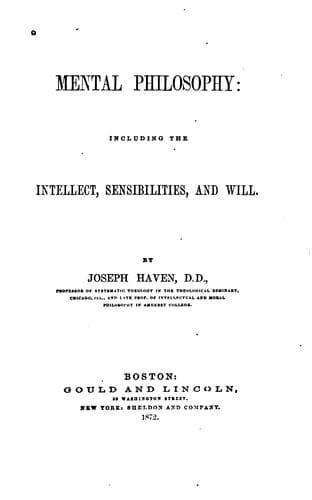
Mental Philosophy: Including the Intellect, Sensibilities, and WillHaven, Joseph
Philosophy
Mental Philosophy: Including the Intellect, Sensibilities, and Will
Haven, Joseph
Psychology
The identity is no longer complete, no longer absolute, because there
is no longer, as in the case of spiritual existence, absolute sameness
of essence. Of the complex being under consideration, animal or
vegetable, the life-principle is, indeed, one and the same throughout
all periods of its existence, but the material organization retains not
the same absolute essence, only the same general structure, and form,
and adaptation of parts, while the parts and particles themselves are
continually changing. It is only in a modified and partial sense, then,
not in strict philosophical use of language, that we can predicate
identity of any material organic existence. We mean by it, simply,
_continuity of life_ under the same general structure and organization;
for so far as it has unity at all, this is it. This enables us to
distinguish such an object from any and all other like objects of the
same kind or sort.
_3. Identity as applied to the third Class._--As regards mere inorganic
matter, its identity consists, again, in its absolute oneness and
sameness. There must be no change of particles, for the essence of
the thing now considered lies not in any peculiarity of form, or
structure, or life-principle, all which are wanting, but simply in the
number and nature of the particles that make up the mass or substance
of the thing, and if these change in the least, it is no longer the
same essence. There is, properly, then, no such thing as identity in
the cases now under consideration, since the particles of any material
substance are liable to constant changes. It is only in a secondary
and popular sense that we speak of the identity of merely inorganic
material substance; strictly speaking, it has no identity, and
continues not the same for any two moments.
We say, however, of two pieces of paper, that they are of the _same_
color, meaning that they are both white or both red; of two coins,
that they are of the same fineness, the same size, and weight, etc.,
meaning, thereby, only that the two things are of the same _sort_ of
color, the same degree of fineness, etc., and not that the color of the
one or the fineness and size of the one is absolutely the essential and
identical color, size, fineness of the other. It is by a similar use
of terms, not in their strict and proper, but in a loose and secondary
sense, that we speak of the identity or sameness of any material
substance in itself considered. Strictly, it has no identity unless
its substance is absolutely unchanged, which is not true of most, if,
indeed, of any material existence, for any successive periods of time.
Public-domain text, read in full here on John Shaqi.
Reviews
Reviews
No reviews yet
Be the first to share your thoughts on this work.
Elsewhere in the archive
Join the Discussion
Join the discussion
Sign in to leave a comment or review.
Sign InorCreate an account