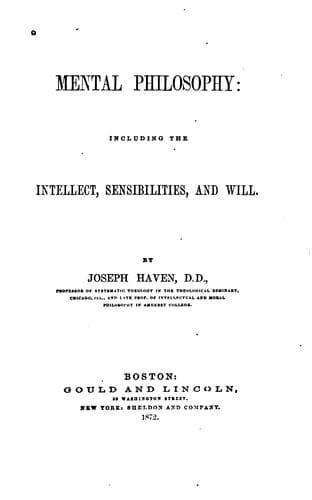
Mental Philosophy: Including the Intellect, Sensibilities, and WillHaven, Joseph
Philosophy
Mental Philosophy: Including the Intellect, Sensibilities, and Will
Haven, Joseph
Psychology
_Constitution of the Mind._--That such is the constitution of the mind,
such the law of its action, admits of no reasonable doubt. No sooner is
an event or phenomenon observed, than we conclude, at once, that it is
an effect, and begin to inquire the cause. We cannot, by any effort of
conception, persuade ourselves that there is absolutely no cause.
_Not derived from Sense._--But is not this principle of causality
derived from experience? We have already said that sense does not give
it. I do not see with the eye the cause of the melting of the wax, much
less does what I see contain the general principle, that _every_ event
must have a cause. Sense does not give me this.
_Whether from Consciousness._--Still, may it not be a matter of
experience in another way, given by _consciousness_, though not by
_sense_. For example, I am conscious of certain volitions. These
volitions are accompanied with certain muscular movements, and these,
again, are followed by certain sensible effects upon surrounding
objects. These changes produced on objects without are directly
connected thus with my own mental states and changes, with the
volitions of which I am directly conscious. Given, the volition on my
part, with the corresponding muscular effort, and the external change
is produced. I never observe it taking place without such preceding
volition. I learn to regard my will as the _cause_, and the external
change as the _effect_. I observe that it is in the power of others
to produce changes in like manner. Thus I obtain the general idea of
cause. It is given by consciousness and experience.
_Notion of Causality not thus derived._--It is to this source that
a very able and ingenious French philosopher would attribute our
first idea of cause. I refer to Maine de Biran. I should agree with
M. de Biran, that consciousness of our own voluntary efforts, and of
the effects thus produced, may give us our first notion of cause.
But it does not give us the law of causality. It extends to a given
instance only, explains that, explains nothing further than that,
cannot go beyond. I am conscious that in this given instance I have
set in operation a train of antecedents and sequences which results
in the given effect. I am not conscious that _every_ event has, in
like manner, a cause. My experience warrants no such assumption. No
induction of facts and cases can possibly amount to this. Induction
can multiply and generalize, but cannot stamp on that which is merely
empirical and contingent, the character of universality and necessity.
The law of causality, in a word, is to be distinguished from any given
instance, or number of instances, of actually observed causation. The
latter fall within the range of consciousness and experience, the
former is given, if at all, as a law of the mind, a primary truth, an
idea of reason.
Public-domain text, read in full here on John Shaqi.
Reviews
Reviews
No reviews yet
Be the first to share your thoughts on this work.
Elsewhere in the archive
Join the Discussion
Join the discussion
Sign in to leave a comment or review.
Sign InorCreate an account