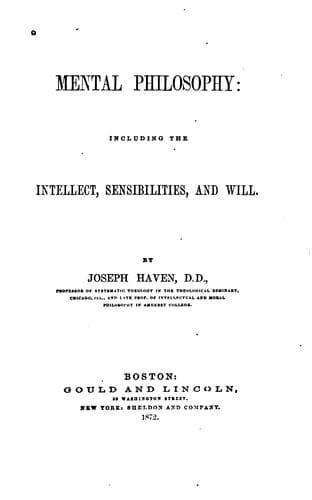
Mental Philosophy: Including the Intellect, Sensibilities, and WillHaven, Joseph
Philosophy
Mental Philosophy: Including the Intellect, Sensibilities, and Will
Haven, Joseph
Psychology
_The Conception of Identity amounts to what._--In every case of
affirmed identity, then, there is implied a possible plurality of
objects; a difference of cognition of a given object, whether one
person cognizant at different times, or different persons at the same
time; a question whether the possible plurality, as regards the object
of these different cognitions, is an _actual_ plurality; a conviction
and decision that it is not, that the object is one and the same; and
this sameness and unity are _absolute_ or _comparative_, according as
we use the language in its strict, primitive, philosophical meaning,
or in its loose and popular sense. In the one case, it is sameness of
absolute essence, in the other, sameness of nominal relation to others
of a series or class.
IV. CAUSE.
_Meaning of the Term._--The idea of cause is one with which every mind
is familiar. It is not easy, however, to explain precisely what we mean
by it, nor to fix its limits, nor to unfold its origin.
We mean by this term, I think, as ordinarily employed, that on which
some consequence depends, that but for which some event or phenomenon
would not occur. In order to affirm that one thing is the cause of
another, I must know, not merely that they are connected, but that the
existence of the one depends on that of the other. This is more than
mere antecedence, however invariable. The approach of a storm may be
invariably indicated by the changes of the barometer. These changes
precede the storm, but are not the cause of it.
_Origin of the Idea._--_Whence do we derive_ the idea of cause?--a
question of some importance, and much discussed.
Evidently not from sense. I observe, for example, the melting of snow
before the fire, or wax before the flame of a taper. What is it that I
see in this case? Merely the phenomenon, nothing more. All that sense
conveys, all that the eye reports, is simply the melting of the one
substance in the presence and vicinity of the other. I _see_ no cause,
no form transmitted from the one to the other, no action of the one on
the other, but simply the vicinity of the two, and the change taking
place in one. I _infer_ that the change takes place in consequence of
the vicinity. I believe it; and if the experiment is often repeated
with the same results, I cannot doubt that it is so. The idea of
causality is, indeed, _suggested_ by what I have seen, but is not
given by sense. I have not seen the cause; that lies hidden, occult,
its nature wholly unknown, and its very existence known, not by what
I have actually seen, but by that law of the mind which leads me to
believe that every event must have a cause, and to look for that cause
in whatever circumstance is known to be invariably connected with the
given change or event.
Public-domain text, read in full here on John Shaqi.
Reviews
Reviews
No reviews yet
Be the first to share your thoughts on this work.
Elsewhere in the archive
Join the Discussion
Join the discussion
Sign in to leave a comment or review.
Sign InorCreate an account