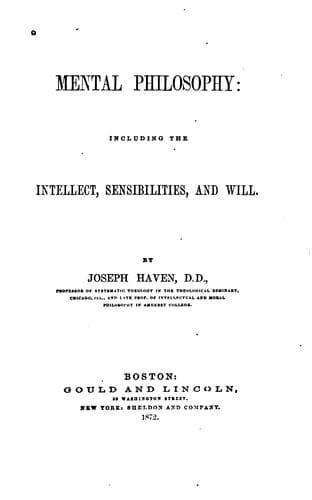
Mental Philosophy: Including the Intellect, Sensibilities, and WillHaven, Joseph
Philosophy
Mental Philosophy: Including the Intellect, Sensibilities, and Will
Haven, Joseph
Psychology
problem, some fixing upon one thing, some upon another; and it may be
instructive to glance at some of these definitions.
_Some make it a Sensation._--Of those who have undertaken to define
what beauty is, there are some who make it a mere _feeling_ or
sensation of the mind, and not an objective reality of any sort. It
is not this, that, or the other quality of the external object, but
simply a subjective emotion. It lies within us, and not without. Thus,
Sir George Mackenzie describes it as "a certain degree of a certain
species of pleasurable effect impressed on the mind." So also Grohman,
Professor of Philosophy at Hamburg, in his treatise on æsthetic as
science, defines the beautiful to be "the infinite consciousness of the
reason as _feeling_." As the true is the activity of reason at work
as _intellect_ or knowledge, and as the good is its province when it
appears as _will_, so the beautiful is its activity in the domain of
_sensibility_. Brown, Upham, and others, among English and American
writers, frequently speak of the emotion of beauty, as if beauty itself
were an emotion.
_Others an Association._--Closely agreeing with this class of writers,
and hardly to be distinguished from it, is that which makes beauty
consist in certain _associations of idea and feeling_ with the
object contemplated. This is the favorite doctrine with the Scotch
metaphysicians. Thus Lord Jeffrey, who has written with great clearness
and force on this subject, regards beauty as dependent entirely on
association, "the reflection of our own inward sensations." It is not,
according to this view, a quality of the object external, but only a
feeling in our own minds. Its seat is within and not without.
_Theory that Beauty consists in Expression._--Of the same general
class, also, are those who, with Alison, Reid, and Cousin, regard
beauty as the _sign_ or _expression_ of some quality fitted to awaken
pleasing emotions in us. Nothing is beautiful, say these writers, which
is not thus expressive of some mental or moral quality or attribute.
It is not an original and independent quality of any peculiar forms or
colors, says Alison, for then we should have a definite rule for the
creation of beauty. It lies ultimately in the mind, not in matter, and
matter becomes beautiful only as it becomes, by analogy or association,
suggestive of mental qualities. The same is substantially the ancient
Platonic view. Kant, also, followed in the main by Schiller and
Fichte, takes the subjective view, and makes beauty a mere play of the
imagination.
_All these Theories make it subjective._--Whether we regard beauty,
then, as a mere emotion, or as an association of thought and feeling
with the external object, or as the sign and expression of mental
qualities, in either case we make it ultimately subjective, and deny
its external objective reality.
Public-domain text, read in full here on John Shaqi.
Reviews
Reviews
No reviews yet
Be the first to share your thoughts on this work.
Elsewhere in the archive
Join the Discussion
Join the discussion
Sign in to leave a comment or review.
Sign InorCreate an account