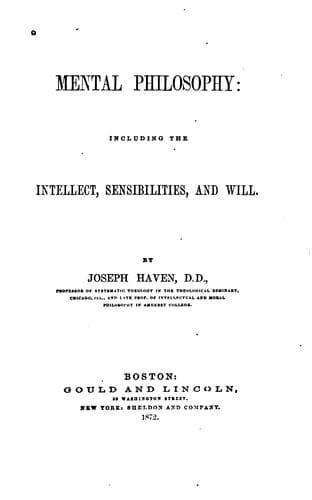
Mental Philosophy: Including the Intellect, Sensibilities, and WillHaven, Joseph
Philosophy
Mental Philosophy: Including the Intellect, Sensibilities, and Will
Haven, Joseph
Psychology
_Different Forms of the objective Theory._--Of those who take the
opposite view, some seek for the hidden principle of beauty in
_novelty_; others, as Galen and Marmontel, in _utility_; others,
as Shaftesbury, Hutcheson, Hogarth, in the principle of _unity in
variety_; others, in that of _order and proportion_, as Aristotle,
Augustine, Crousez.
All these writers, while they admit the existence of beauty in the
external object, make it to consist in some quality or conformation of
matter, as such.
_The spiritual Theory._--There is still another theory of the
beautiful, which, while admitting its external objective reality, seeks
to divest it of that material nature in which the writers last named
present it, and searches for its essence among principles ethereal
and spiritual. According to this view beauty is the _spiritual life
in its immediate sensible manifestation_; the hidden, invisible
principle--spirit in distinction from matter, animating, manifesting
itself in, looking out through, the material form. It is not matter
as such, it is not spirit as such, much less a mere mental quality or
mental feeling; it is the expression of the invisible and spiritual
under sensible material forms. This view was first fully developed
by Schelling and Hegel, and is adopted, in the main, by Jouffroy in
his Cours d'Esthetique, by Dr. August Ruhlert, of the university
of Breslau, in his able system of æsthetics, and by many other
philosophical writers of distinction in Europe.
_Questions for Consideration._--The following questions grow out of
these various and conflicting definitions, as presenting the real
points at issue, and, as such, requiring investigation.
I. Is beauty something objective, or merely subjective and emotional?
II. If the former, then what is it in the object that constitutes its
beauty?
I. _Question stated._--Is beauty merely subjective, an emotion of our
own minds, or is it a quality of objects? When we speak, _e. g._,
of the beauty of a landscape, or of a painting, do we mean merely a
certain excitement of our sensitive nature, a certain feeling awakened
by the object, or do we mean some quality or property belonging to that
object? If the latter, then are we _correct_ in attributing any such
quality to the object?
_Emotion admitted._--Unquestionably, certain pleasing emotions
are awakened in the mind in view of certain objects which we term
beautiful; unquestionably those objects are the cause or occasion of
such emotions; they have, under favorable circumstances, the power
of producing them; unquestionably they have this power by virtue,
moreover, of some quality or property pertaining to them. All this will
be admitted by those who deny the objective reality of beauty. The
question is not, whether there is in the object any quality which is
the occasion or cause of our emotion, but whether the term beauty is
properly the name of that cause, or of the emotion it produces.
Public-domain text, read in full here on John Shaqi.
Reviews
Reviews
No reviews yet
Be the first to share your thoughts on this work.
Elsewhere in the archive
Join the Discussion
Join the discussion
Sign in to leave a comment or review.
Sign InorCreate an account