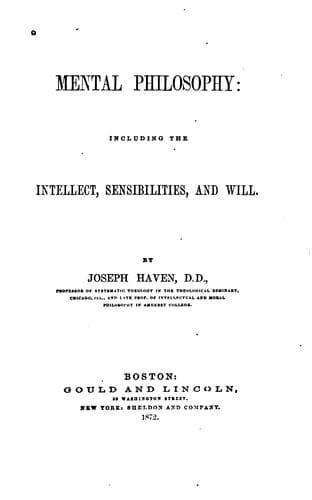
Mental Philosophy: Including the Intellect, Sensibilities, and WillHaven, Joseph
Philosophy
Mental Philosophy: Including the Intellect, Sensibilities, and Will
Haven, Joseph
Psychology
_Reply to the first Argument._--To these arguments I reply, in the
first place, that it is not necessary that a cause should be in actual
operation, under our immediate eye, in order that we should conclude
its independent and constant existence. If, whenever the occasion
returns, the effects are observed, we conclude that the cause exists
_per se_, and not merely in relation to us. Otherwise we could never
believe the absolute existence of any thing, but should, with Berkley
and Hume, call in question the existence of matter itself, save as
phenomenal and relative to our senses. The same argument that makes the
beauty of a rose relative merely to the observer, makes the rose itself
merely a relative existence. How do I know that it exists? I see it,
feel it, smell it; it lies upon my table; it affects my senses. I turn
away now. I leave the room. How do I know _now_ that the rose exists?
It no longer affects my senses; the cause no longer operates; the
effect is no longer produced. I have just as much reason to say it no
longer exists, as to say it is no longer beautiful.
_Reply to the second Argument._--To the argument from the diversity
of effect, I reply, that admitting the fact to be as stated, viz.,
that the same object is differently regarded by different minds, the
diversity may arise from either of two sources. The want of uniformity
may lie in the cause, or it may lie in the minds affected by it. The
exciting cause may vary, and the effects produced by it will then be
diverse; or the minds on which it operates may differ, and in that
case, also, the effects will be diverse. We are not to conclude, then,
from diversity of effect that the cause is not uniform. A beautiful
object, it is true, affects different observers differently, but the
reason of the diversity may be in _them_ and not in the object.
What then is the fact? Are the minds of all observers equally
susceptible of impression from the beautiful? By no means. They differ
in education, habit of thought, culture, taste, native sensibility, and
many other things. Hardly two minds can be found that are not diverse
in these respects. Ought we then to expect absolute uniformity of
effect?
Public-domain text, read in full here on John Shaqi.
Reviews
Reviews
No reviews yet
Be the first to share your thoughts on this work.
Elsewhere in the archive
Join the Discussion
Join the discussion
Sign in to leave a comment or review.
Sign InorCreate an account