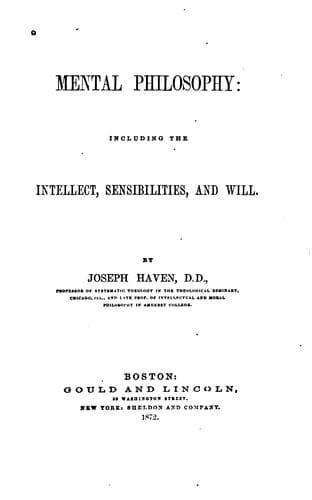
Mental Philosophy: Including the Intellect, Sensibilities, and WillHaven, Joseph
Philosophy
Mental Philosophy: Including the Intellect, Sensibilities, and Will
Haven, Joseph
Psychology
_Not to be conceded that there is no Agreement._--It is by no means
to be conceded, however, that there is no such thing as a standard of
beauty or of taste, no general agreement among men as to what is or
is not beautiful, no general agreement as to the emotions produced.
There is such agreement in both respects. Within certain limits it
is uniform and complete. Certain aspects of nature, and certain works
of art, are, in all ages, and by all men, regarded as beautiful. The
Apollo Belvidere, and the Venus of the Capitol, are to us what they
were to the ancients; the perfection of the beautiful. The great work
of Raphael, scarcely finished at his death, the last touches still
fresh from his hand--that work which, as it hung above his bier, drew
tears from all eyes, and filled with admiration all hearts--is still
the wonder and admiration of men. And so it will be in centuries to
come. And so of the emotions produced by the contemplation of the
beautiful. Making due allowance for habits of association, mental
culture, and differences of native sensibility, we shall find men
affected much in the same way by the beautiful in nature or art. The
men of the same class and condition as to these matters--the peasant
of one age or country, and the peasant of another, the philosopher of
one time, and of another, the wealthy, uneducated citizen, and the
fashionable fool, of one period and nation, and of another--experience
much the same effects in view of one and the same object. The same
general laws, too, preside over and regulate the different arts which
have relation to the beautiful, in all ages of the world.
_Consequences of the Theory that Beauty is merely relative._--If beauty
be not absolute but relative only, it follows, 1. That, if there were
no observers of nature or art, neither would be longer beautiful. 2.
If, for any reason any thing is for the time unseen, as, _e. g._, a
pearl in the sea, a precious stone in the mine, or a rich jewel in the
casket, it has no beauty so long as it is there and thus. 3. As minds
vary in susceptibility of impression, the same thing is beautiful to
one person and not to another; at one time and not at another; nay,
at one and the same moment it is both beautiful and not beautiful,
according as the minds of the observers vary. I cannot say with truth,
that the Mosaics of St. Peter's, or the great diamond of the East,
are, at this moment, really beautiful, because I do not know who, or
whether any one, may, at this moment, be looking at them.
Public-domain text, read in full here on John Shaqi.
Reviews
Reviews
No reviews yet
Be the first to share your thoughts on this work.
Elsewhere in the archive
Join the Discussion
Join the discussion
Sign in to leave a comment or review.
Sign InorCreate an account