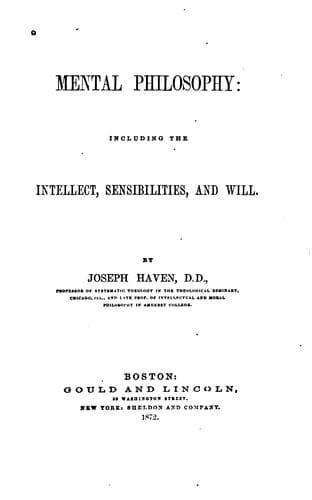
Mental Philosophy: Including the Intellect, Sensibilities, and WillHaven, Joseph
Philosophy
Mental Philosophy: Including the Intellect, Sensibilities, and Will
Haven, Joseph
Psychology
Every thing, when first beheld, is novel; but every thing is not
beautiful. Let us look more closely at the element of novelty. That
is novel which is new to _us_ merely, which appears to us for the
first time. It may be new to the intellect, a new idea, or to the
sensibility, a new feeling, or to the will, a new act. As a new idea it
satisfies our curiosity, as a new feeling it developes our nature, as a
new volition it enlarges the sphere of our activity. In these respects,
and for these reasons, novelty pleases, but in all this we discover no
resemblance to the beautiful.
_Novelty heightens Beauty._--It is not to be denied that novelty, in
many cases, heightens the beauty of an object. By familiarity, we
become, in a measure, insensible to the charms of that which, as first
beheld, filled us with delight. The sensibility receives no further
excitement from that to which it has become accustomed. To enjoy
mountain scenery most highly, one must not always dwell among the
mountains. To enjoy Niagara most highly, one must not live in the sight
of it all his days. But beauty, and the _enjoyment_ of the beautiful,
are surely different things, and while novelty is accessory to the full
effect of the beautiful on our minds, and even indispensable to it, it
is not, itself, the element of beauty, not the ground and substance of
it.
_Not always pleasing._--Jouffroy even denies that novelty is always
pleasing. Some things, he contends, _displease_ us, simply because they
are new. We become accustomed to them, and our dislike ceases. Thus it
is, to some extent, with difference of color in the races.
_Theory of the Useful._--Is, then, the _useful_ the beautiful? This
theory next claims our attention. The foundation of the emotions
awakened in us by the beautiful in nature or art, is the perception
of utility. We perceive in the object a fitness to conduce, in some
way, to our welfare, to serve, in some way, our purposes, and for this
reason, we are pleased. The utility is the beauty.
_The most useful not the most beautiful._--That the beauty of an object
may, in our perception, be heightened by the discovery of its fitness
to produce some desirable end, or rather, that this may add somewhat
to the pleasure we feel in view of the object, is quite possible; that
this is the main element and grand secret, either of that emotion on
our part, or of the beauty which gives rise to it, is not possible. It
is sufficient to say, that, if this were so, the most useful things
ought, of course, to be the most beautiful. Is this the case? A stream
of water conducted along a ship canal is more useful than the same
stream tumbling over the rapids, or plunging over a perpendicular
precipice. Is it also more beautiful? A swine's snout, to use a homely
but forcible illustration of Burke, is admirably fitted to serve the
purpose for which it was intended; useful exceedingly for rooting and
grubbing, but not, on the whole, very beautiful.
Public-domain text, read in full here on John Shaqi.
Reviews
Reviews
No reviews yet
Be the first to share your thoughts on this work.
Elsewhere in the archive
Join the Discussion
Join the discussion
Sign in to leave a comment or review.
Sign InorCreate an account