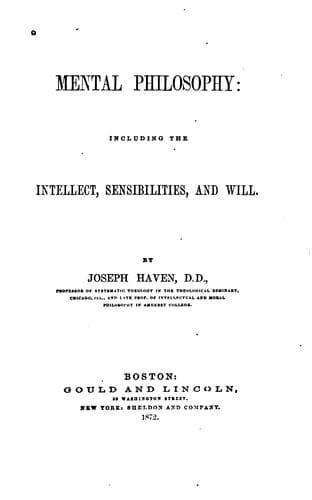
Mental Philosophy: Including the Intellect, Sensibilities, and WillHaven, Joseph
Philosophy
Mental Philosophy: Including the Intellect, Sensibilities, and Will
Haven, Joseph
Psychology
_Dissimilarity of the two._--Indeed, few things can be more unlike, in
their effect upon the mind, in the nature of the emotions they excite,
than the useful and the beautiful. This has been well shown by Jouffroy
in his analysis of the beautiful. Kant has also clearly pointed out the
same thing. Both please us, but not in the same way, not for the same
reason. We love the one for its advantage to us, the other _for its own
sake_. The one is a purely selfish, the other a purely disinterested
love, a noble, elevated emotion. The two are heaven-wide asunder. The
glorious sunset is of no earthly use to us, otherwise than mere beauty
and pleasure are in themselves of use. The gorgeous spectacle becomes
at once degraded in our own estimation by the very question of its
possible utility. We love it not for the benefit it confers, the use
we can make of it, but for its own sake, its own sweet beauty, because
it is what it is. There it lies, pencilled on the clouds, evanescent,
momentarily changing. There it is, afar off. You cannot reach it,
cannot command its stay, have no wish to appropriate it to yourself,
no desire to turn it to your own account, or reap any benefit from
it, other than the mere enjoyment; still you admire it, still it is
beautiful to you. Of what use to the beholder is the ruddy glow and
flash of sunrise on the Alpine summits as seen from the Rhigi or Mount
Blanc? Of what use, in fact, is beauty in any case, other than as it
may be the means of refining the taste, and elevating the mind? That
it has this advantage we are free to admit; and it is certainly one of
the noblest uses to which any thing can be made subservient; but surely
this cannot be what is meant when we are told that beauty _consists_
in utility, for this would be simply affirming that the cause consists
in the effect produced. Beauty refines and elevates the mind, is a
means of æsthetic and moral culture; as such it is of use, and in
that use lies the secret and the subtle essence of beauty itself. In
other words, a given cause produces a given effect, and that effect
_constitutes_ the cause!
Public-domain text, read in full here on John Shaqi.
Reviews
Reviews
No reviews yet
Be the first to share your thoughts on this work.
Elsewhere in the archive
Join the Discussion
Join the discussion
Sign in to leave a comment or review.
Sign InorCreate an account