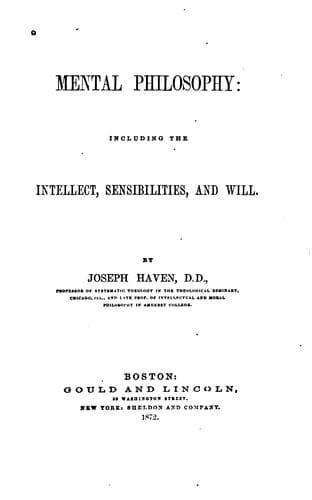
Mental Philosophy: Including the Intellect, Sensibilities, and WillHaven, Joseph
Philosophy
Mental Philosophy: Including the Intellect, Sensibilities, and Will
Haven, Joseph
Psychology
_Analogy of this to the mental Process called Taste._--It is easy to
perceive, now, the analogy between the physical power and process thus
described, and the psychological faculty under consideration, to which
the name primarily denoting the former has been transferred. Objects
in nature and art present themselves to the observation, and awaken
pleasure as beautiful, or excite disgust as the opposite. A mere matter
of sensibility, of feeling, this. Presently, however, we begin to
notice, not the mere feeling of pleasure or aversion, but the character
of the object that awakens it, we discriminate, we attribute to the
object such and such qualities, take cognizance of it as possessing
those qualities. This discriminating power, this judgment of the mind
that the object possesses such properties, we call taste. As, in the
sphere of sense, the feeling awakened affords the means of judging
and distinguishing, as to the qualities of the object, so here. The
beautiful awakens sensation--a vivid feeling of pleasure, delight,
admiration; deformity awakens the reverse; and this feeling enables
us to judge of the object, as regards the property in question, viz.,
beauty or deformity, whether, and how far, as compared with other
objects of the mind, it possesses this quality. In either case--the
physical and the psychological--the process begins with sensation
or feeling, but passes on at once into the domain of intellect, the
sphere of understanding or judgment; and while, in either case, the
word taste may, without impropriety, be used to denote the feeling
or susceptibility of impression which lies at the foundation of the
intellectual process, it is more strictly appropriate to the faculty of
discriminating the objects, and the qualities of objects, which awaken
in us the given emotions.
So far as the word itself can guide us, then, it would seem to be in
the direction now indicated.
_Appeal to Consciousness._--Analogy, however, may mislead us. We must
not base a doctrine or decide a question in psychology upon the meaning
of a single term. Upon observation and consciousness of what actually
passes in our own minds, in view of the beautiful, we must, after all,
rely. Let us place ourselves, then, in the presence of the beautiful in
nature or art, and observe the various mental phenomena that present
themselves to our consciousness.
I stand before a statue of Thorwalsden or Canova. The spell and
inspiration of high art are upon me. What passes now in my mind?
Public-domain text, read in full here on John Shaqi.
Reviews
Reviews
No reviews yet
Be the first to share your thoughts on this work.
Elsewhere in the archive
Join the Discussion
Join the discussion
Sign in to leave a comment or review.
Sign InorCreate an account