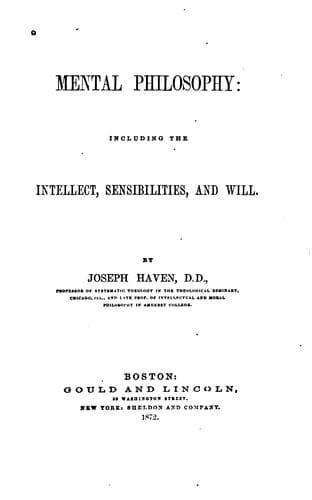
Mental Philosophy: Including the Intellect, Sensibilities, and WillHaven, Joseph
Philosophy
Mental Philosophy: Including the Intellect, Sensibilities, and Will
Haven, Joseph
Psychology
_Etymology of the Term._--To some extent the word itself may guide us.
Borrowed, as are most if not all words expressing mental states and
acts, from the sphere of sense, there was doubtless some reason why
this word in particular was selected to denote the power of the mind
now under consideration. Some close analogy, doubtless, was supposed to
exist between the physical state denoted by this word in its primary
sense, and the mental faculty to which we refer, so that, in seeking
for a term by which to designate that intellectual faculty, none would
more readily present itself, as appropriate and suggestive of the
mental state intended, than the one in question. This analogy, whatever
it be, while it cannot be taken as decisive of the question before us,
is still an element not to be overlooked by the psychologist. What,
then, is the analogy? How comes this word--_taste_--to be used, rather
than any other, to denote the idea and power now under consideration?
_Taste as a Sense._--In the domain of sense, certain objects brought
in contact with the appropriate physical organ, affect us as sweet,
sour, bitter, etc. This is purely an affection of the sensibility,
mere feeling. We say the thing _tastes_ so and so. The power of
distinguishing such qualities we call the power or sense of taste.
Primarily mere sensation, mere feeling, we transfer the word to denote
the power of judging by means of that sensation. There is, in the
first instance, an affection of the organ by the object brought in
contact with it, of which affection we are cognizant; then follows an
intellectual perception or judgment that the object thus affecting us,
possesses such and such qualities, is sweet, sour, bitter, salt, etc..
The sensation affords the ground of the judgment. The latter is based
upon the former. The sensation, the simple feeling, affords the means
of discriminating, judging, distinguishing, and to this latter power
or process the word taste, in the physical sense, is more frequently
appropriated. We say of such or such a man, his taste is acute, or his
taste is impaired, or dull, etc., meaning his power of perceiving and
distinguishing the various properties of objects which affect his sense
of taste.
Public-domain text, read in full here on John Shaqi.
Reviews
Reviews
No reviews yet
Be the first to share your thoughts on this work.
Elsewhere in the archive
Join the Discussion
Join the discussion
Sign in to leave a comment or review.
Sign InorCreate an account