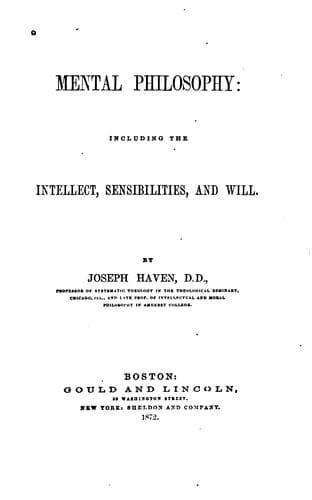
Mental Philosophy: Including the Intellect, Sensibilities, and WillHaven, Joseph
Philosophy
Mental Philosophy: Including the Intellect, Sensibilities, and Will
Haven, Joseph
Psychology
ground and data upon which, after all, taste must rely in its decisions.
_Cultivation of Taste._--We have investigated, with some care, as was
proposed, the nature of that power of the mind which takes cognizance
of the beautiful. On the cultivation of this power, a few words must be
said in this connection. Taste is an intellectual faculty, a perceptive
power, a matter of judgment, and, as such, both admits and requires
cultivation. No forms of mental activity depend more on education and
exercise, for their full development, than that class to which we give
the general name of judgment, and no form of judgment more than that
which we call taste. The mind uncultivated, untrained, unused to the
nice perception of the beautiful, can no more judge correctly, in
matters of taste, than the mind unaccustomed to judge of the distance,
magnitude, or chemical properties of bodies, can form correct decisions
upon these subjects. It must be trained by art, and strengthened by
exercise. It must be made familiar with the laws, and conversant
with the forms of beauty. It must be taught to observe and study the
beautiful, in nature and in art, to discriminate, to compare, to judge.
The works in literature and in art which have received the approbation
of time, and the honorable verdict of mankind, as well as the objects
in nature which have commanded the admiration of the race, must become
familiar, not by observation only, but by careful study. Thus may taste
be cultivated.
HISTORICAL SKETCH.
_View of Plato._--Among the ancients, _Plato_ was, perhaps, the first
to distinguish the idea of the beautiful from other kindred ideas, and
to point out its affinity with the true and the good, thus recognizing
in it something immutable and eternal. In making the good and the
beautiful identical, however, he mistakes the true character and end of
art, Previously to Plato, and even by him, art and the beautiful were
treated only in connection with ethics and politics' æsthetics, as a
distinct department of science, was not known to the ancients.
_Of Aristotle._--_Aristotle_ has not treated of the beautiful but
only of dramatic art. Poetry, he thinks, originates in the tendency
to imitate, and the desire to know. Tragedy is the imitation of _the
better_. Painting should represent, in like manner, not _what is_,
but what _ought to be_. In this sense, may be understood his profound
remark, that _poetry is more true than history_.
Public-domain text, read in full here on John Shaqi.
Reviews
Reviews
No reviews yet
Be the first to share your thoughts on this work.
Elsewhere in the archive
Join the Discussion
Join the discussion
Sign in to leave a comment or review.
Sign InorCreate an account