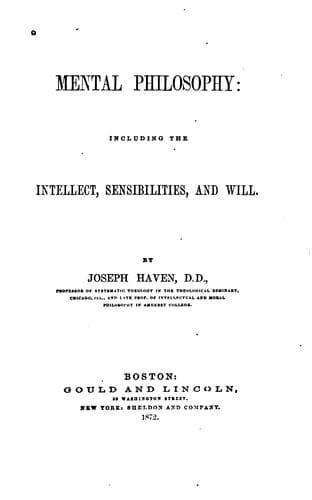
Mental Philosophy: Including the Intellect, Sensibilities, and WillHaven, Joseph
Philosophy
Mental Philosophy: Including the Intellect, Sensibilities, and Will
Haven, Joseph
Psychology
_Plotinus and Augustine._--After Aristotle, _Plotinus_ and _Augustine_
alone, among the ancients, have treated of the beautiful. The work of
Augustine is not extant. It is known that he made beauty consist in
unity and fitness of parts, as in music. The treatise of Plotinus is
regarded as at once beautiful and profound. Material beauty is, with
him, only the expression or reflection of spiritual beauty. The soul
alone, the mind, is beautiful, and in loving the beautiful, the soul
loves its own image as there expressed. Hence, the soul must, itself,
be beautiful, in order to comprehend and feel beauty. The tendency of
this theory is to mysticism.
_Longinus and Quintilian._--Longinus, and Quintilian, treat of the
sublime, only with reference to eloquence and oratory; so, also,
Horace, of art, as having to do with poetry.
_Bacon._--Among the moderns, _Bacon_ recognizes the fine arts as among
the sciences, and poetry as one of the three chief branches of human
knowledge, but nowhere, that I am aware, treats of the beautiful,
distinctly, as such.
_School of Leibnitz._--It was the school of _Leibnitz_ and _Wolf_ in
Germany that first made the beautiful a distinct science. Baumgarten,
disciple of Wolf, first conceived this idea. Like Plato, however, he
makes the beautiful too nearly identical with the good and with morals.
_School of Locke._--In England, the school of _Locke_ have much to
say of beauty. Shaftesbury and Hutcheson, while they do not clearly
distinguish between the beautiful and the good, adopt the theory of
unity in variety, as already explained. Hogarth falls into the same
class, his idea of beauty being represented by the waving line. Burke
does not distinguish sufficiently between the sublime and the terrible.
_French Encyclopedists._--In France, the _Encyclopedists_ coincide,
essentially, with the school of Locke, and treat of the beautiful,
chiefly in its moral aspect.
_The later Germans._--In Germany, again, _Winckelman_, an artist, and
not a philosopher, seizing the spirit of the Greek art, ascribes, as
Plato had done, the idea of beauty to God, from whom it passes into
sensible things, as his manifestations.
In opposition to this ideal and divine aspect, _Lessing_ takes a more
practical view, regarding the beautiful from the stand-point of the
_real_. _Herder_ and _Goethe_ contribute, also, much to the science of
æsthetics. All these do little more than prepare the way for _Kant_,
who goes more profoundly into the philosophy of the matter. He makes
beauty a _subjective_ affair, a play of the imagination.
_Schiller_ makes it the joint product of the reason and the
sensibility, but still a _subjective_ matter, as Kant.
Public-domain text, read in full here on John Shaqi.
Reviews
Reviews
No reviews yet
Be the first to share your thoughts on this work.
Elsewhere in the archive
Join the Discussion
Join the discussion
Sign in to leave a comment or review.
Sign InorCreate an account