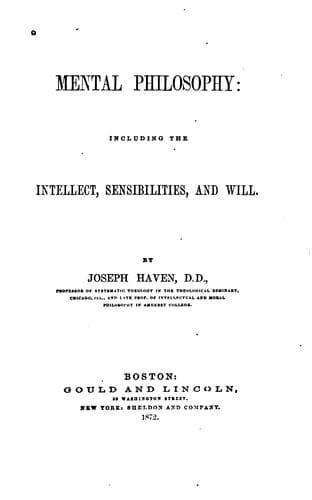
Mental Philosophy: Including the Intellect, Sensibilities, and WillHaven, Joseph
Philosophy
Mental Philosophy: Including the Intellect, Sensibilities, and Will
Haven, Joseph
Psychology
_Universally prevalent._--When we direct our attention to any given
instance of the voluntary action of any intelligent rational being,
we find ourselves not unfrequently pronouncing upon its character as
a _right_ or _wrong_ act. Especially is this the case when the act
contemplated is of a marked and unusual character. The question at once
arises, is it right? Or, it may be, without the consciousness of even a
question respecting it, our decision follows instantly upon the mental
apprehension of the act itself--this thing is right, that thing is
wrong. Our decision may be correct or incorrect; our perception of the
real nature of the act may be clear or obscure; it may make a stronger
or weaker impression on the mind, according to our mental habits, the
tone of our mental nature, and the degree to which we have cultivated
the moral faculty. There may be minds so degraded, and natures so
perverted, that the moral character of an act shall be quite mistaken,
or quite overlooked in many cases; or, when perceived, it shall make
little impression on them. Even in such minds, however, the _idea_ of
right and wrong still finds a place, and the understanding applies
it, though not perhaps always correctly, to particular instances of
human conduct. There is no reason to believe that any mind possessing
ordinary endowments, that degree of reason and intelligence which
nature usually bestows, is destitute of this idea, or fails altogether
to apply it to its own acts, and those of others.
_The Question and its different Answers._--But here an important
question presents itself: _Whence come_ these ideas and perceptions;
their origin? How is it, why is it, that we pronounce an act right or
wrong, when once fairly apprehended? How come we by these notions? The
fact is admitted; the explanations vary. By one class of writers our
ideas of this nature have been ascribed to _education_ and _fashion_;
by another, to _legal restriction_, human or divine. Others, again,
viewing these ideas as the offspring of nature, have assigned them
either to the operation of a _special sense_, given for this specific
purpose, as the eye for vision; or to the joint action of certain
associated emotions; while others regard them as originating in an
exercise of _judgment_, and others still, as _natural intuitions_ of
the mind, or reason exercised on subjects of a moral nature.
_Main Question._--The main question is, are these ideas _natural_,
or _artificial and acquired_? If the latter, are they the result
of education, or of legal restraint? If the former, are they to be
referred to the _sensibilities_, as the result of a special sense or
of association, or to the _intellect_, as the result of the faculty of
judgment or as intuitions of reason?
Public-domain text, read in full here on John Shaqi.
Reviews
Reviews
No reviews yet
Be the first to share your thoughts on this work.
Elsewhere in the archive
Join the Discussion
Join the discussion
Sign in to leave a comment or review.
Sign InorCreate an account