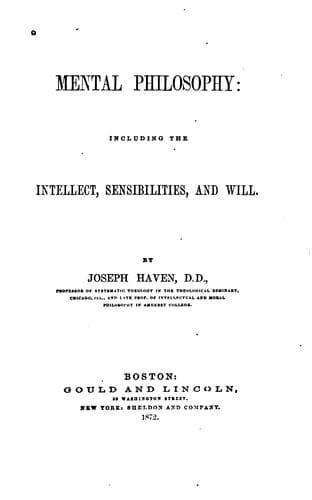
Mental Philosophy: Including the Intellect, Sensibilities, and WillHaven, Joseph
Philosophy
Mental Philosophy: Including the Intellect, Sensibilities, and Will
Haven, Joseph
Psychology
1. _Education._--Come they from _Education and Imitation?_--So Locke,
Paley, and others, have supposed. Locke was led to take this view, by
tracing, as he did, all simple ideas, except those of our own mental
operations, to sensation, as their source. This allows, of course,
no place for the ideas of right and wrong, which, accordingly, he
concluded, cannot be natural ideas, but must be the result of education.
_Objection to this View._--Now it is to be conceded that education
and fashion are powerful instruments in the culture of the mind.
Their influence is not to be overlooked in estimating the causes that
shape and direct the opinions of men, and the tendencies of an age.
But they do not account for the _origin_ of any thing. This has been
ably and clearly shown by Dugald Stewart, in answer to Locke; and it
is a sufficient answer. Education and imitation both _presuppose_
the existence of moral ideas and distinctions; the very things to be
accounted for. How came they who first taught these distinctions, and
they who first set the example of making such distinctions, to be
themselves in possession of these ideas? Whence did _they_ derive them?
Who taught _them_, and set _them_ the example? This is a question not
answered by the theory now under consideration. It gives us, therefore,
and can give us, no account of the origin of the ideas in question.
2. _Legal Enactment._--Do we then derive these ideas from legal
_restriction and enactment_? So teach some able writers. Laws are made,
human and divine, requiring us to do thus and thus, and forbidding such
and such things, and hence we get our ideas originally of right and
wrong.
_Presupposes Right._--If this be so, then, previous to all law, there
could have been no such ideas, of course. But does not law _presuppose_
the idea of right and wrong? Is it not built on that idea as its basis?
How, then, can it originate that on which itself depends, and which it
presupposes? The first law ever promulgated must have been either a
just or an unjust law, or else of no moral character. If the latter,
how could a law which was neither just nor unjust, have suggested to
the subjects of it any such ideas? If the former, then these qualities,
and the ideas of them, must have existed _prior_ to the law itself; and
whoever made the law and conferred on it its character, must have had
already, in his own mind, the idea of the right and its opposite. It is
evident that we cannot, in this way, account for the _origin_ of the
ideas in question. We are no nearer the solution of the problem than
before.
In opposition to the views now considered, we must regard the ideas
in question, as, directly or indirectly, the work of nature, and the
result of our constitution. The question still remains, however, in
which of the several ways indicated, does this result take place?
Public-domain text, read in full here on John Shaqi.
Reviews
Reviews
No reviews yet
Be the first to share your thoughts on this work.
Elsewhere in the archive
Join the Discussion
Join the discussion
Sign in to leave a comment or review.
Sign InorCreate an account