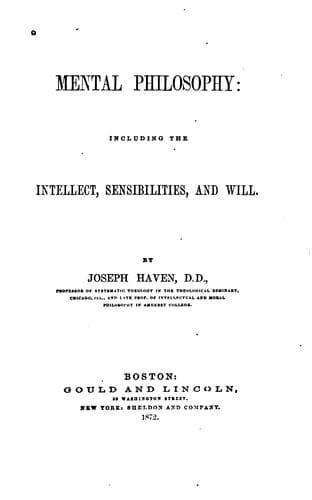
Mental Philosophy: Including the Intellect, Sensibilities, and WillHaven, Joseph
Philosophy
Mental Philosophy: Including the Intellect, Sensibilities, and Will
Haven, Joseph
Psychology
_Makes Conscience a mere Sentiment._--It will be perceived that this
theory, which is indebted chiefly to Mackintosh for its completeness,
and scientific form, makes conscience wholly a matter of sentiment
and feeling; standing in this respect, on the same ground with the
theory of a special sense, and liable, in part, to the same objections.
Hence the name _sentimental_ school, often employed to designate,
collectively, the adherents of each of these views. While the theory,
now proposed, might seem then to offer a plausible account of the
manner in which our moral _sentiments_ arise, it does not account for
the origin of our _ideas_ and _perceptions_ of moral rectitude. Now
the moral faculty is not a mere sentiment. There is an intellectual
perception of one thing as right, and another as wrong; and the
question now before us is, Whence comes that perception, and the
idea on which it is based? To resolve the whole matter into certain
transferred and associated emotions, is to give up the inherent
distinction of right and wrong as qualities of actions, and make virtue
and vice creations of the sensibility, the play and product of the
excited feelings. To admit the perception and idea of the right, and
ascribe their origin to antecedent emotion, is, moreover, to reverse
the natural order and law of psychological operation, which bases
emotion on perception, and not perception on emotion. We do not first
admire, love, hate, and then perceive, but the reverse.
_Further Objections._--The view now under consideration, while it seems
to resolve the moral faculty into mere feeling, thus making morality
wholly a relative affair, makes conscience, itself, an acquired,
rather than a natural faculty, a secondary process, a transformation
of emotions, rather than itself an original principle. It does it,
moreover, the further injustice of deriving its origin from the purely
_selfish_ principles of our nature. I receive a favor, or an injury;
hence I regard, with certain feelings of complacency, or the opposite,
the man who has thus treated me. These feelings I come gradually to
transfer to, and associate with, the act in itself considered, and this
with other acts of the same nature; and so, at last, I come to have a
moral faculty, and pronounce one thing right, and another wrong.
_At Variance with Facts._--This view is quite inadmissible; at
variance with facts, and the well-known laws of the human mind. The
moral faculty is one of the earliest to develop itself. It appears
in childhood, manifesting itself, not as an acquired and secondary
principle, the result of a complicated process of associated and
transferred emotion, requiring time for its gradual formation and
growth, but rather as an original instinctive principle of nature.
Public-domain text, read in full here on John Shaqi.
Reviews
Reviews
No reviews yet
Be the first to share your thoughts on this work.
Elsewhere in the archive
Join the Discussion
Join the discussion
Sign in to leave a comment or review.
Sign InorCreate an account