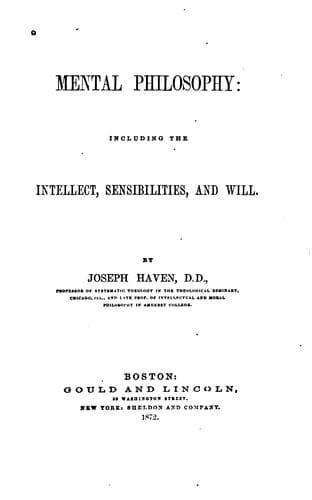
Mental Philosophy: Including the Intellect, Sensibilities, and WillHaven, Joseph
Philosophy
Mental Philosophy: Including the Intellect, Sensibilities, and Will
Haven, Joseph
Psychology
_Sympathy._--Adam Smith, in his "Theory of Moral Sentiments," has
proposed a view which falls properly under the general theory of
association, and may be regarded as a modification of it. He attributes
our moral perceptions to the feeling of _sympathy_. To adopt the
feelings of another is to approve them. If those feelings are such as
would naturally be awakened in us by the same objects, we approve them
as morally proper. Sympathy with the gratitude of one who has received
a favor, leads us to regard the benefaction as meritorious. Sympathy
with the resentment of an injured man, leads us to regard the injurer
as worthy of punishment, and so the sense of demerit originates;
sympathy with the feelings of others respecting our own conduct gives
rise to self-approval and sense of duty. Rules of morality are merely a
summary of these sentiments.
_This View not sustained by Consciousness._--Whatever credit may be
due to this ingenious writer, for calling attention to a principle
which had not been sufficiently taken into account by preceding
philosophers, we cannot but regard it as an insufficient explanation
of the present case. In the first place, we are not _conscious_ of
the element of sympathy in the decisions and perceptions of the moral
faculty. We look at a given action of right or wrong, and approve of
it, or condemn it _on that ground_, because it _is_ right or wrong,
not because we sympathize with the feelings awakened by the act in the
minds of others. If the process now supposed intervened between our
knowledge of the act, and our judgment of its morality, we should know
it and recognize it as a distinct element.
_No imperative Character._--Furthermore, sympathy, like other emotions,
has no _imperative_ character, and, even if it might be supposed to
suggest to the mind some idea of moral distinctions, cannot of itself
furnish a foundation for those feelings of _obligation_ which accompany
and characterize the decisions of the moral faculty.
_The Standard of Right._--But more than this, the view now taken
makes the standard of right and wrong _variable_, and dependent on
the feelings of men. We must know how others think and feel, how the
thing affects them, before we can know whether a given act is right or
wrong, to be performed or avoided. And then, furthermore, our feelings
must agree with theirs; there must be sympathy and harmony of views
and feelings, else the result will not follow. If any thing prevents
us from knowing what are the feelings of others with respect to a
given course of conduct, or if for any reason we fail to sympathize
with those feelings, we can have no conscience in the matter. As those
feelings vary, so will our moral perceptions vary. We have no fixed
standard. There is no place left for right, as such, and absolutely. If
no sympathy, then no duty, no right, no morality.
Public-domain text, read in full here on John Shaqi.
Reviews
Reviews
No reviews yet
Be the first to share your thoughts on this work.
Elsewhere in the archive
Join the Discussion
Join the discussion
Sign in to leave a comment or review.
Sign InorCreate an account