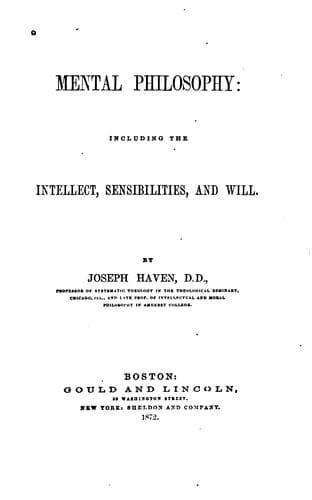
Mental Philosophy: Including the Intellect, Sensibilities, and WillHaven, Joseph
Philosophy
Mental Philosophy: Including the Intellect, Sensibilities, and Will
Haven, Joseph
Psychology
_General Uniformity._--We are by no means disposed to admit, however,
that the diversity in men's moral judgments is so great, as might, at
first, appear. There is, on the contrary, a general uniformity. As to
the great essential principles of morals, men, after all, do judge much
alike, in different ages and different countries. In details, they
differ, in general principles, they agree. In the application of the
rules of morality to particular actions, they differ widely, according
to circumstances; in the recognition of the right and the wrong, as
distinctive principles, and of obligation to do the right as known, and
avoid the wrong as known, in this they agree. It must be remembered,
moreover, that men do not always act according to their own ideas of
right. From the general neglect of virtue, in any age or community, and
the prevalence of great and revolting crimes, we cannot safely infer
the absence, or even the perversion, of the moral faculty.
_Precisely in what the Diversity consists._--It is important to bear in
mind, throughout this discussion, the distinction between the _idea_
of right, in itself considered, and the _perception_ of a given act
as right; the one a simple conception, the other an act of judgment;
the one an idea derived from the very constitution of the mind,
connate, if not innate, the other an application of that idea, by the
understanding, to particular instances of conduct. The former, the
_idea_ of moral distinctions, may be universal, necessary, absolute,
unerring; the latter, the _application_ of the idea to particular
instances, and the decision that such and such acts are, or are not,
right, may be altogether an incorrect and mistaken judgment. Now it is
precisely at this point that the diversity in the moral judgments of
mankind makes its appearance. In recognizing the distinction of right
and wrong, they agree; in the application of the same to particular
instances in deciding _what_ is right and _what_ is wrong--a simple act
of the judgment, an exercise of the understanding, as we have seen--in
this it is that they differ. And the difference is no greater, and no
more inexplicable, with respect to this, than in any other class of
judgments.
Public-domain text, read in full here on John Shaqi.
Reviews
Reviews
No reviews yet
Be the first to share your thoughts on this work.
Elsewhere in the archive
Join the Discussion
Join the discussion
Sign in to leave a comment or review.
Sign InorCreate an account