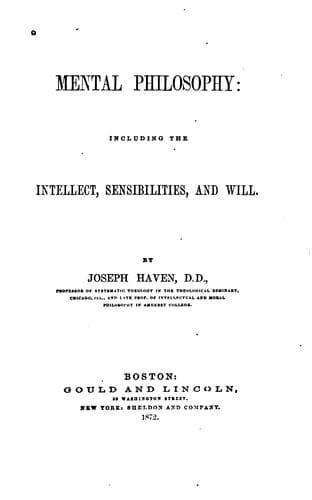
Mental Philosophy: Including the Intellect, Sensibilities, and WillHaven, Joseph
Philosophy
Mental Philosophy: Including the Intellect, Sensibilities, and Will
Haven, Joseph
Psychology
_Conscience not always a safe Guide._--I have admitted that conscience
is not infallible. Is it, then, a safe guide? Are we, in all cases to
follow its decisions? Since liable to err, it cannot be, in itself, I
reply, in all cases, a safe guide. We cannot conclude, with certainty,
that a given course is right, simply because conscience approves it.
This does not, of necessity, follow. The decision that a given act is
right, or not, is simply a matter of judgment; and the judgment may,
or may not, be correct. That depends on circumstances, on education
partly, on the light we have, be it more or less. Conscientious men
are not always in the right. We may do wrong conscientiously. Saul of
Tarsus was a conscientious persecutor, and verily thought he was doing
God service. No doubt, many of the most intolerant and relentless
bigots have been equally conscientious, and equally mistaken. Such men
are all the more dangerous, because doing what they believe to be right.
_It is, nevertheless, to be followed._--What, then, are we to do? Shall
we follow a guide thus liable to err? Yes, I reply, follow conscience;
but see that it be a right and well-informed conscience, forming its
judgments, not from impulse, passion, prejudice, the bias of habit,
or of unreflecting custom, but from the clearest light of reason, and
especially of the divine word. We are responsible for the judgments we
form in morals, as much as for any class of our judgments; responsible,
in other words, for the sort of conscience we have. Saul's mistake lay,
not in acting according to his conscientious convictions of duty, but
in not having a more enlightened conscience. He should have formed a
more careful judgment; have inquired more diligently after the right
way. To say, however, that a man ought not to do what conscience
approves, is to say that he ought not to do what he sincerely believes
to be right. This would be a very strange rule in morals.
Public-domain text, read in full here on John Shaqi.
Reviews
Reviews
No reviews yet
Be the first to share your thoughts on this work.
Elsewhere in the archive
Join the Discussion
Join the discussion
Sign in to leave a comment or review.
Sign InorCreate an account