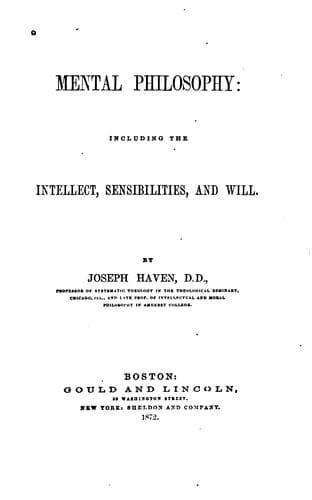
Mental Philosophy: Including the Intellect, Sensibilities, and WillHaven, Joseph
Philosophy
Mental Philosophy: Including the Intellect, Sensibilities, and Will
Haven, Joseph
Psychology
_View of Descartes._--Descartes, perceiving the error of previous
philosophers, went to the opposite extreme, and resolved the instinct
and action of the brute into mere mechanism, a principle little
different from that by which the weight moves the hands of the clock.
The brute performs the functions of his nature and organization, just
as the puppet moves hither and thither by springs hidden within, of
which itself knows nothing. The bird, the bee, the ant, the spider,
are so organized, such is the hidden mechanism of their curious
nature, that at the proper times, and under the requisite conditions,
they shall build, each its own proper structure; and perform, each,
its own proper work and office. So doing, each moves automatically,
mechanically.
_Locke and his Disciples._--Differing, again, from this view, which
certainly ascribes too little, as the opposite theory ascribes too
much to the brute, Locke, Condillac, and their disciples in France
and England, took the ground that the actions of the brute which seem
to indicate intelligence, are to be ascribed to the power of habit,
and to the law of association. The faculties of the brute, as indeed
of man, resolve themselves ultimately into impressions from without.
Nothing is innate. The dog scents his prey, and the beaver builds his
dam, and the bird migrates to a warmer clime, from the mere force of
habit, unreflecting, unintelligent. But how, it may occur to some one
to ask, happens such a habit to be formed in the first place? How
happens the poor insect, just emerging from the egg, to find in himself
all requisite appliances and instruments for capturing his prey? How
happens the bee always, throughout all its generations, to hit upon the
same contrivance for storing its honey, and not only so, but to select
out of a thousand different forms, and different possible angles,
always the same one? And so of the ant, the spider, etc. And if this is
a matter of education, as it certainly is not, then how came the first
bee, the first ant, spider, or other insect, to hit upon so admirable
an expedient?
_The Scotch Philosophers._--On the other hand, Reid, Stewart, and
the Scotch philosophers generally, departing widely from the merely
mechanical view, have ascribed to instinct some actions which are
properly automatic and involuntary, as the shutting of the eyelid on
the approach of a foreign body, the action of the infant in obtaining
its food from the mother's breast, and certain other like movements
of the animal organization, which, according to recent discoveries in
physiology, are to be attributed, rather to the simple reflex action of
the nerves and muscles. This is not properly instinct.
Public-domain text, read in full here on John Shaqi.
Reviews
Reviews
No reviews yet
Be the first to share your thoughts on this work.
Elsewhere in the archive
Join the Discussion
Join the discussion
Sign in to leave a comment or review.
Sign InorCreate an account