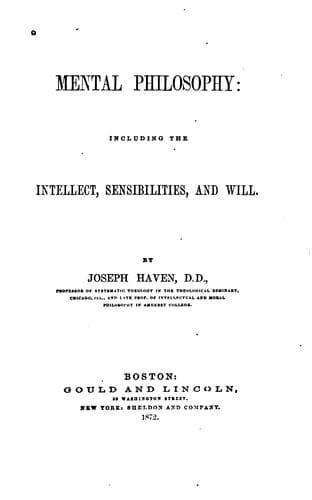
Mental Philosophy: Including the Intellect, Sensibilities, and WillHaven, Joseph
Philosophy
Mental Philosophy: Including the Intellect, Sensibilities, and Will
Haven, Joseph
Psychology
_These Facts do not prove Reason._--Facts of this nature, however
interesting, and well authenticated, must be regarded rather as
exceptions to the ordinary rule, the nearest approach which mere
instinct has been known to make toward the dividing line that separates
the brute from the human intelligence. They do not, in themselves,
prove the existence of reason, of a discriminating and reflecting
intelligence, on the part of the animal; for the same law of nature
that impels the creature to build its nest or its comb, under ordinary
circumstances, in the ordinary manner, may certainly be supposed
to be capable of inducing a change of operation to meet a sudden
exigency, and one liable at any time to occur. It is certainly not
more wonderful, nor so wonderful, that the bee should be induced to
brace her comb, or the spider her web, when in danger, as that either
should be able to construct her edifice originally, at the precise
angle employed. It must be remembered, moreover, that, in the great
majority of cases, brute instinct shows no such capacity of adaptation
to circumstances.
_The Question before us._--We are ready now to inquire how far that
which we call instinct in the brute, differs from that which we call
intelligence in man. Is it a difference in _kind_, or only in _degree_?
A glance at the history of the doctrine may aid us here.
_Early Views._--From Aristotle to Descartes, philosophers took
the latter view. They ascribed to the brute a degree of reason,
such as would be requisite in man, were he to do the same things,
and proceeding on this principle, they attributed to animals
an intelligence proportioned to the wants of their nature and
organization. This principle, it need hardly be said, is an assumption.
It is not certain that the same action proceeds from the same principle
in man, and in the brute; that whatever indicates and involves
intelligence and reason, in the one case, as its source, involves the
same in the other. This is a virtual _petitio principii_. It assumes
the very point in question. It may be that what man does by virtue of
an intelligent, reflecting, rational soul, looking before and after,
the brute does by virtue of entirely a different principle, a mere
unintelligent impulse of his nature, a blind sensation, prompting him
to a given course. This is the question to be settled, the thing to be
proved or disproved. And if the view already given of the character of
brute instinct, is correct, the position now stated as possible, may be
regarded as virtually established.
Public-domain text, read in full here on John Shaqi.
Reviews
Reviews
No reviews yet
Be the first to share your thoughts on this work.
Elsewhere in the archive
Join the Discussion
Join the discussion
Sign in to leave a comment or review.
Sign InorCreate an account