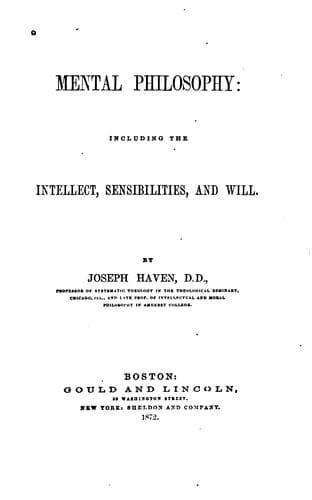
Mental Philosophy: Including the Intellect, Sensibilities, and WillHaven, Joseph
Philosophy
Mental Philosophy: Including the Intellect, Sensibilities, and Will
Haven, Joseph
Psychology
_Memory in the Brute._--It may still be asked, does not the brute
_remember_? It is the office of memory to replace or represent what
has been once felt or perceived. It simply reproduces, in thought,
what has once passed before the mind. It originates nothing. Whatever,
then, of intelligence was involved in the original act of perception
and sensation, so much and no more is involved in the replacing
those sensations and perceptions. If in the original act there was
nothing but simple sensation, without intellectual apprehension of
the object, without self-consciousness or distinction of subject from
object, then, of course, nothing more than this will be subsequently
reproduced. Mere images or phantasms of sensible objects may reappear,
as shadows flicker and dance upon the wall, or as such images flit
before us in our dreams. The memory of the brute is, probably, of this
nature, rather a sort of dream than a distinct conception of past
events. What was not clearly apprehended at first, will not be better
understood now. Failing, in the first instance, to distinguish self
from the object external, as the source of impressions, there can be no
_recognition_ of that distinction when the object reappears, if it ever
should, in conception. The essential element of memory, which connects
the object or event of former perception with _self_ as the percipient,
must, in such a case, be wanting.
_The Brute associates rather than remembers._--What is usually
called memory in the brute, is not, however, so much his capacity of
conceiving of an absent object of sense, as his recognition of the
object when again actually present to his senses. The dog manifests
pleasure at the appearance of his master, and the horse chooses the
road that leads to his former home. This is not so much memory as
association of ideas or rather of feelings. Certain feelings and
sensations are associated, confusedly blended, with certain objects.
The reappearance of the objects, of course, reawakens the former
feelings. Thus, the whip is associated with the sensation experienced
in connection with it. So, too, a horse which has once been frightened
by some object beside the road, will manifest fear on subsequently
approaching the same place, although the same object may no longer
be there. The surrounding objects which still remain, and which
were associated with the more immediate object of fear in the first
instance, are sufficient to awaken, on their reappearance, the former
unpleasant sensations.
A being endowed with intelligence and reason would connect the
recurring object, in such a case, with his own former experience as the
perceiving subject, would recall the time and the circumstances of the
event and its connection with his personal history. This would be,
properly, an act of memory.
Public-domain text, read in full here on John Shaqi.
Reviews
Reviews
No reviews yet
Be the first to share your thoughts on this work.
Elsewhere in the archive
Join the Discussion
Join the discussion
Sign in to leave a comment or review.
Sign InorCreate an account