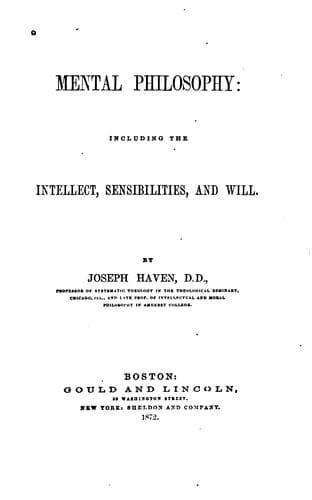
Mental Philosophy: Including the Intellect, Sensibilities, and WillHaven, Joseph
Philosophy
Mental Philosophy: Including the Intellect, Sensibilities, and Will
Haven, Joseph
Psychology
_Not peculiar to this Department of the Science._--The difficulty in
question, however, is one which, in reality, pertains to all mental
science, and not to this department of it alone; and so Hume, in the
passage cited by Mr. Stewart, seems to intend. It is true that while
we are under the influence of any exciting emotion, we are in no mood,
and in no suitable state to observe, with critical eye, the workings of
our own minds; neither are we in any condition to do so when engaged in
the less exciting, but not less absorbing _intellectual_ occupation of
reasoning, or imagining, or remembering. The moment we begin to observe
ourselves as thus engaged, the mind is no longer employed as before,
the experiment which we wish to observe is interrupted, and instead of
reasoning, imagining, or remembering, we are only observing ourselves.
Our only resource, in either case, is to turn back and gather up, as
well as we can from _memory_, the data of our mental activity and
condition while thus and thus employed. And this we can do with regard
to the action of the sensibilities, as well as of the intellect,
provided only the degree of emotion and excitement is not so great as
to interfere with the present consciousness, and so with the subsequent
recollection of what was passing in our own minds.
_Sources of Information._--Nor are we dependent entirely on
self-observation. Our sources of information are twofold, the
observation of our own minds, and of others. From the latter source
we may learn much of the nature of this department of mental action.
The sensibilities of others are more open to our inspection, and less
readily mistaken, than their intellectual states. Nor do we meet, in
this case, with the same difficulty; for however excited and incapable
of self-inspection, at the moment, the subject of any strong emotion or
passion may be, the spectator, at least, is able to observe the effect
of that passion, and note its phenomena, with calm and careful eye.
CHAPTER II.
ANALYSIS AND CLASSIFICATION OF THE SENSIBILITIES.
_Certain Distinctions may be noticed._--Including, under the term
sensibility, according to the definition already given, whatever is of
the nature of _feeling_, in distinction from thought or cognition, and
limiting the term also to feelings strictly _mental_, in distinction
from merely physical sensation, it is obvious that there are certain
leading distinctions still to be observed in this class of our mental
states, certain great and strongly marked divisions or differences,
by which we shall do well to be guided in our arrangement and
classification of them. Our feelings are many and various; it is
impossible to enumerate or classify them with perfect precision; yet
there are certain points of resemblance and difference among them,
certain groups or classes into which they naturally divide themselves.
Public-domain text, read in full here on John Shaqi.
Reviews
Reviews
No reviews yet
Be the first to share your thoughts on this work.
Elsewhere in the archive
Join the Discussion
Join the discussion
Sign in to leave a comment or review.
Sign InorCreate an account