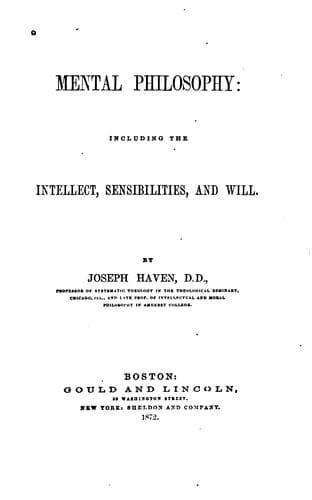
Mental Philosophy: Including the Intellect, Sensibilities, and WillHaven, Joseph
Philosophy
Mental Philosophy: Including the Intellect, Sensibilities, and Will
Haven, Joseph
Psychology
_A general Distinction indicated._--One general distinction lies at
the outset, patent and obvious, running through all forms and modes of
sensibility, namely, the difference of _agreeable_ and _disagreeable_.
Every feeling is, in its very nature, and of necessity, one or the
other, either pleasing or painful. In some cases the distinction is
much more strongly marked than in others; sometimes it may be hardly
perceptible, and it may be difficult to determine, so slight is the
degree of either, whether the feeling under consideration partakes of
the character of pleasure or pain; sometimes there is a blending of the
two elements, and the same emotion is at once pleasing and painful to
the mind that experiences it. But I cannot conceive of a feeling that
is neither agreeable or disagreeable, but positively indifferent. The
state of indifference is not an exercise of sensibility, but a simple
_want_ of it, as the very name denotes by which we most appropriately
express this state of mind, _i. e._, _apathy_ ([Greek: a pathos]).
_Simple Emotions._--Passing this general and obvious distinction, we
find among our sensibilities a large class which we may denominate
_simple emotions_. These comprise the joys and sorrows of life in all
their varieties of modification and degree, according as the objects
which awaken them differ. Under this class fall those general states of
the mind which, without assuming a definite and obvious form, impart a
tinge and coloring of joyousness or sadness to all our activity. Under
this class, also, must be included the more specific forms of feeling,
such as the grief or sorrow we feel at the loss of friends, sympathy
with the happiness or sorrow of others, the enjoyment arising from the
contemplation or persuasion of our own superiority, and the chagrin of
the reverse, the enjoyment of the ludicrous, of the new and wonderful,
of the beautiful, to which must be added the satisfaction resulting
from the consciousness of right action, and those vivid feelings of
regret in view of the wrong, which, in their higher degree, assume
the name of remorse, and fall like a chill and fearful shadow over
the troubled path of earthly life. These all are simple emotions, and
all, moreover, are but so many forms of joy and sorrow, varying as the
objects vary which give rise to them.
_Further Difference of instinctive and rational Emotion._--It will
be observed, however, that of these several specific forms of simple
emotion, some are of a higher order than the others. Such are those
last named in the series, the feelings awakened in view of the
ludicrous, in view of the new and wonderful, in view of the beautiful,
and in view of the right, or, in general, the æsthetic and moral
emotions. These, as seeming to possess a higher dignity, and to involve
a higher degree of intellectual development, we may denominate the
_rational_, in distinction from the other simple emotions, which, to
mark the difference, we may term _instinctive_.
Public-domain text, read in full here on John Shaqi.
Reviews
Reviews
No reviews yet
Be the first to share your thoughts on this work.
Elsewhere in the archive
Join the Discussion
Join the discussion
Sign in to leave a comment or review.
Sign InorCreate an account