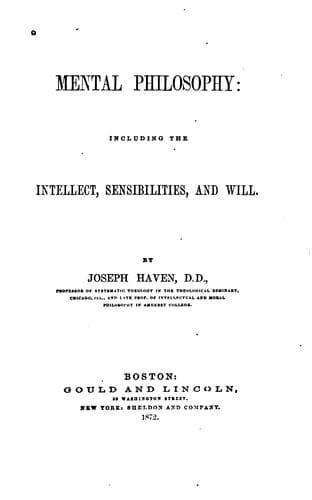
Mental Philosophy: Including the Intellect, Sensibilities, and WillHaven, Joseph
Philosophy
Mental Philosophy: Including the Intellect, Sensibilities, and Will
Haven, Joseph
Psychology
_Silence of deep Grief._--The deepest sorrow is not always, perhaps
not usually, the most violent and demonstrative. It is when the first
sudden passion of grief is passed and the soul retires within herself
to meditate upon her loss, calmly gathering her mantle about her to
hide from the observation of others those tears and that sorrow which
are sacred, it is then that the deepest sorrow, and the heaviest
darkness gather about the burdened spirit. The truest, deepest grief
is ever silent. It shrinks from human observation. It finds no words
for expression, wishes none. It is a veiled and silent goddess, whose
rites and altars are hidden from the eye of day. It is the nature of
joy to communicate itself. It is the nature of sorrow, whatever may be
the occasion whence it springs, to retire within itself. It seeks its
chamber that it may weep there.
_Effect of Time in assuaging Sorrow._--The effect of time in softening
and allaying the violence of grief, is known to every one. The manner
in which this effect is produced is worthy of attention. A recurrence
to the laws of suggestion may explain this. It will be recollected that
among the secondary or subjective laws which regulate the suggestion
of our thoughts, the interval of time which has elapsed since the
occurrence of any event holds an important place. That which has
taken place but recently is more likely to recur again to mind than
events of remoter date. On the first occurrence of any calamity, or
bereavement, every thing tends to remind us of our loss, and this
constant suggestion of it has a powerful effect in keeping alive our
sorrow. As time passes on, however, the objects which once suggested
only that which we had lost, become associated with, and so suggest
other objects and occurrences; or, if they still remind us of our loss,
the remembrance is mingled with that of other scenes and events which
have since transpired, and other feelings which have since agitated our
hearts. Thus time is constantly mingling other ingredients in the cup
of our grief. The law of _the most recent_ still holds in suggestion,
and thus the very principle that formerly reminded us continually of
our loss, now shuts it out, by interposing between it and us what has
since transpired. The thought of the past comes up less frequently, and
when it recurs, is mingled with so many other associated objects, and
experiences, that it no longer awakens emotions of unmitigated grief.
Gradually other objects interest us, other plans and duties engage us,
other emotions agitate the heart, as successive waves beat on the same
troubled shore, and render fainter, at each return, the traces which
former billows had impressed upon its sands.
Public-domain text, read in full here on John Shaqi.
Reviews
Reviews
No reviews yet
Be the first to share your thoughts on this work.
Elsewhere in the archive
Join the Discussion
Join the discussion
Sign in to leave a comment or review.
Sign InorCreate an account