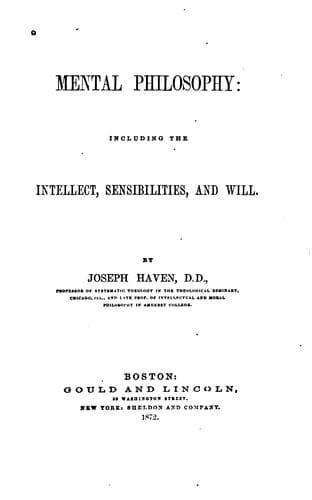
Mental Philosophy: Including the Intellect, Sensibilities, and WillHaven, Joseph
Philosophy
Mental Philosophy: Including the Intellect, Sensibilities, and Will
Haven, Joseph
Psychology
_Nature and Objects of this Emotion._--Among those susceptibilities
which, while implanted in our nature, and springing into exercise by
their own spontaneous energy, imply in their operation the exercise
of the reflective powers, and in general, of the higher intellectual
faculties, and which on that account, we designate as _rational_,
in distinction from the _instinctive_ emotions, a prominent place
is due to those vivid feelings of pleasure, and pain, with which we
contemplate any real or supposed excellence, or defect, in ourselves.
The direct object of the emotions now under consideration, is self in
some form or aspect. The immediate cause of these emotions is some real
or fancied excellence which we possess, or, on the other hand, some
real or imagined deficiency. This excellence or deficiency may pertain
to our intellectual or to our moral qualities and attainments, or even
to our circumstances and condition in life, to any thing, in short,
which is _ours_, and which distinguishes us from our fellows. The
quality contemplated may be a real possession and attainment, or it may
exist only in our imagination and conceit. And so, also, of the defect;
that, too, may be real, or imaginary. In either case, vivid feelings
are awakened in the mind. It is impossible to contemplate ourselves
either as possessing or as lacking any desirable quality without
emotion, pleasing or painful, and that in a high degree.
_In what Manner awakened._--These emotions are awakened in either
of two ways: by the simple contemplation of the supposed excellence,
or defect, in _themselves_ considered as pertaining to us; or, more
frequently, by _the comparison of ourselves with others_ in these
respects. It is to the feelings awakened, in the latter case, by the
perceived superiority or inferiority of ourselves to others, as the
result of such comparison, that the terms pride and humility are
ordinarily applied. These terms are relative, and imply, always, some
process of comparison. There may be, however, the painful consciousness
of defect, or the pleasing consciousness of some high and noble
attainment, when the relation which we sustain to others, as regards
these points, forms no part of the object of contemplation. The
comparison is not of ourselves with others, but only of our present
with our former selves. We are satisfied and delighted at our own
progress and improvement, or humbled and cast down at our repeated
failure, and manifest deficiency.
Public-domain text, read in full here on John Shaqi.
Reviews
Reviews
No reviews yet
Be the first to share your thoughts on this work.
Elsewhere in the archive
Join the Discussion
Join the discussion
Sign in to leave a comment or review.
Sign InorCreate an account