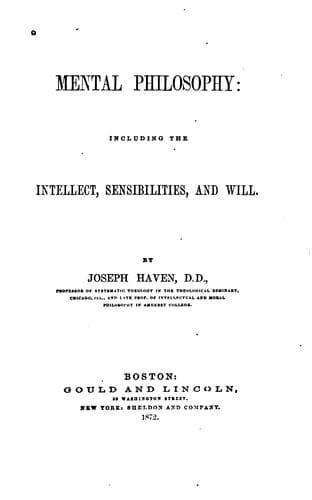
Mental Philosophy: Including the Intellect, Sensibilities, and WillHaven, Joseph
Philosophy
Mental Philosophy: Including the Intellect, Sensibilities, and Will
Haven, Joseph
Psychology
_Not the same with moral Emotion._--The emotions now under
consideration must not be confounded with the satisfaction which arises
in view of moral worthiness, and the regret and disapprobation with
which we view our past conduct as morally wrong. The emotions of which
we now speak, are not of the nature of moral emotion, however closely
allied in some respects. It is not the verdict of an approving or
condemning conscience that awakens them. They have no reference to the
right as such. The object is viewed, not in the light of obligation or
duty, but merely as a _good_, a thing agreeable and desirable. Thus
viewed, its possession gives us pleasure, its absence, pain.
_Not blame-worthy in itself._--In the simple emotion thus awakened, the
satisfaction and pleasure with which we regard our own intellectual and
moral attainments, or even our external circumstances, there is nothing
blamable or unworthy of the true man. It is simply the working of
nature. The susceptibility to such emotion is part of our constitution,
implanted and inherent. As Dr. Brown has well remarked, it is
impossible to desire excellence, and not to rejoice at its attainment;
and if it is culpable to feel pleasure at attainments which have made
us nobler than we were before, it must, of course, have been culpable
to desire such excellence.
_In what Cases the Emotion becomes culpable._--It is only when the
emotion exists in an undue degree, or with regard to unworthy objects,
when the supposed excellence upon which we congratulate ourselves
really does not exist, or, when existing, we are disposed to set
ourselves up above others on account of it, and perhaps to look down
upon others for the lack of it, or even to make them feel by our manner
and bearing what and how great the difference is between them and us;
it is only under such forms and modifications, that the feeling becomes
culpable and odious. These it not unfrequently assumes. They are the
states of mind commonly denoted by the term _pride_, as the word is
used in common speech; and the censure usually and very justly attached
to the state of mind designated by that term, must be understood as
applicable to the disposition and feelings now described, and not to
the simple emotion of pleasure in view of our own real or supposed
attainments. That which we condemn in the proud man is not that he
excels others, or is conscious of thus excelling, or takes pleasure
even in that consciousness, but that, comparing himself with others,
and feeling his superiority, he is disposed to think more highly of
himself than he ought, on account of it, and more contemptuously of
others than he ought, and especially if he seeks to impress others with
the sense of that superiority.
Public-domain text, read in full here on John Shaqi.
Reviews
Reviews
No reviews yet
Be the first to share your thoughts on this work.
Elsewhere in the archive
Join the Discussion
Join the discussion
Sign in to leave a comment or review.
Sign InorCreate an account