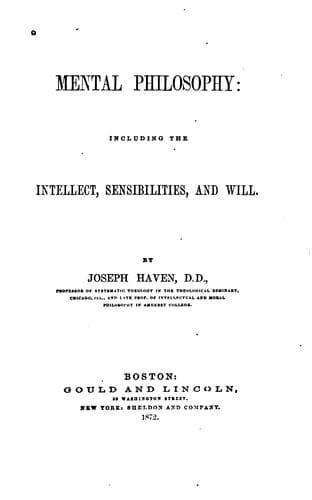
Mental Philosophy: Including the Intellect, Sensibilities, and WillHaven, Joseph
Philosophy
Mental Philosophy: Including the Intellect, Sensibilities, and Will
Haven, Joseph
Psychology
_Accidental grouping of incongruous Ideas._--When the incongruity is
that not of _objects_, but of _ideas_ brought into new and unexpected
relation, and when this is the result of accident or awkwardness,
rather than of design, we have what is termed a _blunder_ or a _bull_.
In such a case there is always involved some inconsistency between
the thing meant, and the thing said or done. There is an apparent
congruity, but a real incongruity of the related ideas. An instance of
this occurs in the anecdote related by Sydney Smith, of a physician,
who, being present where the conversation turned upon an English
nobleman of rank and fortune, but without children, remarked, with
great seriousness, that to be childless was a misfortune, but he
thought he had observed that it was _hereditary_ in some families.
Of this nature is most of the wit which we call Irish; the result of
accident rather than design--a blunder, a bull. It is said that during
the late rebellion in Ireland, the enraged populace, on a certain
occasion, vented their wrath against a famous banker, by solemnly
resolving to burn all his bank-notes which they could lay hands on;
forgetting, in their rage, that this was only to make themselves so
much the poorer, and him so much the richer. The instance given by Mr.
Mahan is also in point, of two Irishmen walking together through the
woods, the foremost of whom seizing a branch, as he passed along, and
holding it for a while, suddenly let it fly back, whereby his companion
behind was suddenly reduced to a horizontal position, but on recovering
himself, congratulated his associate on having held back the branch as
long as he did, since it must otherwise have killed him.
_Intentional grouping of incongruous Ideas._--The _intentional_
grouping of incongruous ideas, for the purpose of exciting the feeling
of the ludicrous, is more properly denominated _wit_. This, again,
may assume diverse forms. Where the ideas are entirely dissimilar,
but have a name or sound in common, which similarity of mere sound or
name is seized upon as the basis of comparison, the wit takes the name
of a _pun_. The more complete the incongruity of the two ideas, thus
brought into strange and unexpected relation, under cover of a word,
the more perfect the pun, and the more ludicrous the effect. This kind
of wit is deservedly reckoned as inferior. "By unremitting exertions,"
says a quaint writer, "it has been at last put under, and driven into
cloisters, from whence it must never again be suffered to emerge into
the light of the world." One invaluable blessing, adds the same author,
produced by the banishment of punning is, an immediate reduction of the
number of wits.
Public-domain text, read in full here on John Shaqi.
Reviews
Reviews
No reviews yet
Be the first to share your thoughts on this work.
Elsewhere in the archive
Join the Discussion
Join the discussion
Sign in to leave a comment or review.
Sign InorCreate an account