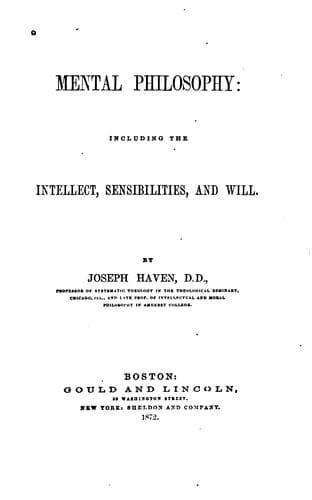
Mental Philosophy: Including the Intellect, Sensibilities, and WillHaven, Joseph
Philosophy
Mental Philosophy: Including the Intellect, Sensibilities, and Will
Haven, Joseph
Psychology
_The Burlesque._--When the wit is employed in debasing what is great
and imposing, by applying thereto figures and phrases that are mean and
contemptible, it takes the name of _burlesque_. The pages of Hudibras
afford abundant illustrations of this form of the ludicrous. The
battle of Don Quixote and the wind-mills is a burlesque on the ancient
tournaments.
_The Mock-Heroic._--The mock-heroic, by a contrary process, provokes
the sense of the ridiculous by investing what is inconsiderable and
mean with high-sounding epithets and dignified description. The battle
of the mice and frogs is an instance of this.
_The double Meaning._--Beside the varieties of intentional incongruity
of ideas already mentioned, there are certain less important forms
of witticism, which can perhaps hardly be classed under any of the
foregoing divisions. The whole tribe of _double entendres_, or double
meanings, where one thing is said and another thing is meant, or
at least where the apparent and honest is not the only or the real
meaning; _satire_, which is only a modification of the same principle,
drawn out into somewhat more extended and dignified discourse, and
which, under the form of apparent praise, hides the shafts of ridicule
and invective; _sarcasm_, which conveys the intended censure and
invective in a somewhat more indirect and oblique manner;--these are
all but various modes of what we have called intentional incongruity of
ideas.
_This Principle, in what Respects of dangerous Tendency._--Of the
value of this principle of our nature, I have as yet said nothing. To
estimate it at its true worth, is not altogether an easy thing. On
the one hand, there can be little doubt that, carried to excess, it
becomes a dangerous principle. The tendency to view all things, even
perhaps the most sacred, in a ludicrous light, and to discover fanciful
and remote relations between objects and ideas the most diverse and
incongruous, must exert an unhappy influence on the general tone and
character of both the mind and the heart. Where wit, or the disposition
to the ludicrous, becomes the predominant quality of the mind,
impressing the other and nobler faculties into its lawless service, it
must be to the detriment of the mind's highest energies and capacities;
to the detriment especially of that sincerity and honesty of purpose,
and that earnest love of truth, which are the foundation of all true
greatness. I speak in this of the excess and abuse of wit; I speak of
the _mere_ wit.
Public-domain text, read in full here on John Shaqi.
Reviews
Reviews
No reviews yet
Be the first to share your thoughts on this work.
Elsewhere in the archive
Join the Discussion
Join the discussion
Sign in to leave a comment or review.
Sign InorCreate an account