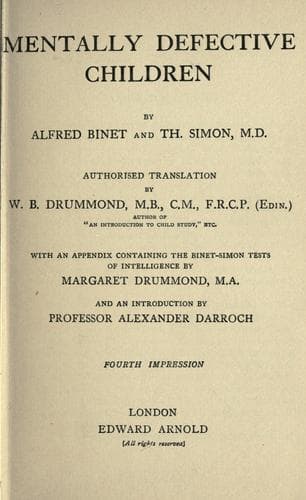
Children with mental disabilities -- Education; Children with mental disabilities -- Psychological testing
Let us try, however, to interpret the silence of the text. In four
years 240 boys have left the school at Bicêtre. In studying the school
of the Salpêtrière we distinguished three classes of children--the
_improved_, the _stationary_ or _doubtful_, and those who have got
_worse_. We have consulted the statistical tables of Bicêtre, and we
have not found a single one marked _worse_, although one-third of the
entire contingent are epileptic. Now, this is very surprising, since
we know that epilepsy with repeated fits inexorably results in mental
decadence. It is an enigma, which we explain in the following manner:
Those who are really decadent have been marked _stationary_ by
medical or pedagogical optimism. If our interpretation is correct, it
recoils forcibly upon the expression _improved_, which is applied
frequently to those discharged. To the interpretation of this word
_improved_ we are, therefore, obliged to turn our attention.
What, then, must be understood by _improved_ when this word is found
in the publications of Bicêtre? First of all we must subtract a
certain number of subjects who have been marked _transferred_. We know
what is meant by this little word _transferred_ when it is applied to
the children. It is lugubrious. It amounts to a sentence for life. A
subject _transferred_ is one who, his time at school come to an end,
is removed to an asylum for the insane, where, in all probability, he
will stay to the end of his useless existence. If we eliminate the
transferred, and if we keep amongst the improved only those who,
having been so designated, have returned to their families, we get a
proportion of 58 in 290--that is, 20 per cent. of boys.
This proportion seems to us too large, on account of the optimism
which these documents exhibit. It is to be noticed, however, that
children are sometimes marked _very much improved_, or _notably
improved_. If, for the sake of prudence, we consider as improved only
those who are designated in this way, we have only eighteen, or 7 per
cent.
This new proportion, if small in absolute value, still seems to us an
exaggeration, because it is reached only by including a certain number
of children affected with epilepsy. It must, therefore, be believed
that their epilepsy has improved. But the amelioration or cure of
epilepsy is not a matter of education; it cannot be considered as a
success to be credited to active medico-pedagogical treatment. Let us
therefore put the cured epileptics aside. There will then remain only
seven who have undergone a notable amelioration and have returned to
their families. What percentage is this? The total contingent upon
which we have been making our calculations numbered 290, but it is
right to exclude all the epileptics, for the reasons we have
mentioned. This brings the number down to 216, and the number of
children really improved, calculated upon 216, amounts, for the boys,
to from 3 to 4 per cent.
Public-domain text, read in full here on John Shaqi.
Reviews
Reviews
No reviews yet
Be the first to share your thoughts on this work.
Elsewhere in the archive
Join the Discussion
Join the discussion
Sign in to leave a comment or review.
Sign InorCreate an account