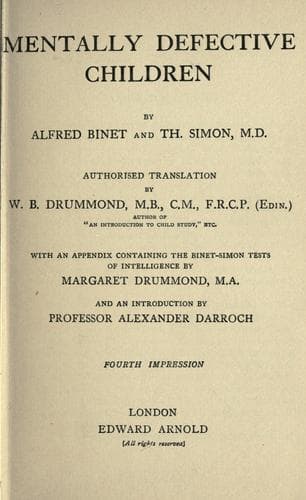
Children with mental disabilities -- Education; Children with mental disabilities -- Psychological testing
By similar calculations, into the details of which we will not enter,
we have shown that the improved amongst the girls are more
numerous--namely, 20 per cent. But Vallée contains relatively far
fewer epileptics than Bicêtre. We do not know, also, how many of them
have become capable of working at a trade.
We therefore conclude with the following propositions:
1. _At the school of the Salpêtrière, 20 per cent. of defective girls
improved, and 12 per cent. are able to work at a trade._
2. _At the Fondation Vallée, also, 20 per cent. of defective girls
have improved. No return has been furnished as to their future
employment._
3. _In the case of Bicêtre, the number of defective boys improved is
from 3 to 4 per cent. It is not known how many of these defectives are
employed after leaving school._
* * * * *
=Some Conclusions.=--It seldom happens that one finishes an inquiry
without experiencing some disappointment. One starts with great
ambitions, intending to make everything plain, but on the way one is
forced to lower one's flag. The truth escapes one. Sometimes it is the
facts which conceal it from us, sometimes it is man who has an
interest in concealing it. But the disappointment which has attended
our inquiry would surpass the foresight of the most sceptical. On the
other hand, if the school for defectives at the Salpêtrière has
enabled us to collect valuable information, we owe this good fortune
entirely to the intelligent initiative of a woman. It was the
directress of the school who, apart from all intervention, medical or
other, had had the idea of instituting these very complete schedules,
which enabled us to discover the economic return of her school. The
management deserved none of the credit. As to the school of Bicêtre,
we have studied it only through its annual publications, and we have
managed with great difficulty to obtain only an infinitesimal amount
of information of very doubtful value.
What lessons are we to draw from these examples as to the future
organisation of our schools for defectives? We had hoped that the
study of these institutions would have provided us with ready-made
experience as to the measures to be taken for founding schools for
defectives under good conditions. The contrary has happened. The
example of these institutions has taught us one thing--the faults
which we ought not to repeat.
Every impartial mind ought to be with us when we express the view that
henceforth the activities of the schools and hospices should be made
plain by precise information. For this it would be necessary to take
the following measures:
Public-domain text, read in full here on John Shaqi.
Reviews
Reviews
No reviews yet
Be the first to share your thoughts on this work.
Elsewhere in the archive
Join the Discussion
Join the discussion
Sign in to leave a comment or review.
Sign InorCreate an account