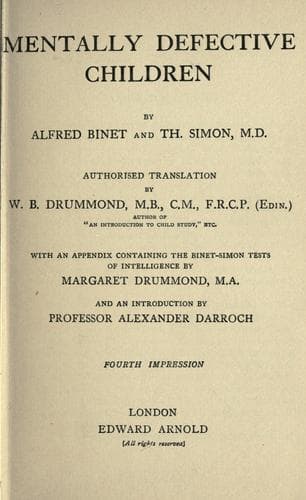
Children with mental disabilities -- Education; Children with mental disabilities -- Psychological testing
One day, when we were walking through a residential school, we were
struck by the spectacle of a poor epileptic. This was a little girl of
about fifteen years of age. She was wearing her school apron, and upon
her head was the little osier cap which epileptics are made to wear,
to avoid the danger of falls upon the head. It was lesson-time. Pale
and thin, the little patient was sitting quietly in her place,
listening to the lesson of her mistress, who was explaining the rule
of the agreement of the participle. Did she understand? We hope so,
since she belonged to one of the higher classes--the second, if we
remember rightly. In any case, she was making a great effort to follow
the grammatical explanation, and her forehead was thrown into
wrinkles. All at once she gave a slight sigh, slipped down in her
seat, and fell. The attendant took her in her arms and carried her
into a corner of the room. The lesson continued with general
indifference. The children pay little attention to such accidents,
because they are so used to them. Now one, now another, has her attack
of epilepsy. After a few minutes our little scholar came to herself.
She appeared quite dazed. The attendant spoke to her with kind
indifference. "Come, now, that is better. It is nothing. It is all
over." The child did not reply, but docilely allowed herself to be led
to her seat. She took up her former position, appearing to listen
vaguely; and on her pinched face, with its drawn features, the lesson
in grammar continued to fall. The people, visitors and professors, who
were present at that scene, and thought it quite natural, surely did
not understand the heart-break of it. Some time afterwards we made
inquiries about this pupil, being curious to know how she was, and
what she was doing. We were told: "She is a poor little thing, who has
forgotten a great deal. Formerly she was a bright child. Now she is
going back every day. By-and-by she will no longer be able to read.
This is nearly always the way with our epileptics!"
This sad story, which we have just recalled, we give as a striking
illustration of our statistical calculations regarding the ultimate
fate of these institution cases. Be it remembered, we had reached this
very important conclusion: that epileptics, whether feeble-minded, or
imbecile, or idiotic, never become capable of working at a trade. This
somewhat vague conclusion it would be of great interest to examine
more closely. Our little epileptic, who is gradually falling back, is
an example. She has already reached the height of her development; she
is fifteen years of age, and she is beginning to decline. We foresee
the time when she will no longer know how to read. Is there, then,
any use in wearying the poor thing by teaching her an abstract grammar
rule?
* * * * *
Public-domain text, read in full here on John Shaqi.
Reviews
Reviews
No reviews yet
Be the first to share your thoughts on this work.
Elsewhere in the archive
Join the Discussion
Join the discussion
Sign in to leave a comment or review.
Sign InorCreate an account