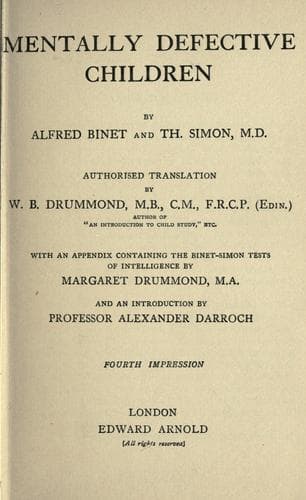
Children with mental disabilities -- Education; Children with mental disabilities -- Psychological testing
Let us turn now to our school cases. Our conclusions may be divined.
We expressly demand that the utility of the schools shall be
rigorously established, and that the teachers and inspectors shall be
bound to take exact notes of the mental condition and the state of
instruction of the pupils on entrance and on leaving. In this way one
will act like any good shopkeeper, who considers it one of his chief
duties to keep accounts of what he is doing. His system of
book-keeping shows his position in a way which is indispensable if he
is not to lose his money. He knows at what price he buys, at what
price and under what conditions he sells, and whether, in consequence,
his profits are sufficient to encourage him to continue to deal in
such and such articles.
In the same way, in a well-managed school for defectives, it is
necessary to know the exact details concerning the condition of the
pupils on entrance and on leaving, in order that one may be able to
judge the services rendered by the school; in order that one may be
able to find out whether the educational methods employed are good,
bad, or indifferent; whether they are better than those of another
school, where different methods are followed, and so on. Such control
is equally necessary in order to find out whether a particular
category of children gives greater degrees of success than another;
whether certain degrees of mental deficiency are capable of
improvement only to an infinitesimal extent. Such things cannot be
known in advance, and should not be decided lightly in credence of an
_a priori_ opinion, but should be determined by accurate scientific
methods, in the interest of the schools, in the interest of the
pupils, and also in the interest of the tax-payers, who bear the cost.
It will not do to content oneself with admiring _in abstracto_ the
goodness of the methods and the progress of the pupils, but it must
ever be remembered that the aim of the schools should be to fit the
defectives to take a useful place in society. The school should not
aim at turning out brilliant pupils, stars in competition, but
individuals capable of looking after themselves and gaining their own
livelihood. This should be the constant pre-occupation of the
teachers. They should not shut themselves up within the four walls of
their school, saying, "The life outside is no concern of ours." It is
their imperative duty to consider the school life as a preparation for
life outside. They ought, therefore, to pay attention to the needs of
the immediate school environment, in order to know what are the
industries which require workers, to take account of which of them are
accessible to defectives, and to direct their education accordingly.
Domestic service in the country, for example, which requires but
little initiative, would seem to be an excellent refuge for
feeble-minded girls with good instincts. Agricultural labour supplies
an excellent outlet for the boys, for in the country life is less
Public-domain text, read in full here on John Shaqi.
Reviews
Reviews
No reviews yet
Be the first to share your thoughts on this work.
Elsewhere in the archive
Join the Discussion
Join the discussion
Sign in to leave a comment or review.
Sign InorCreate an account