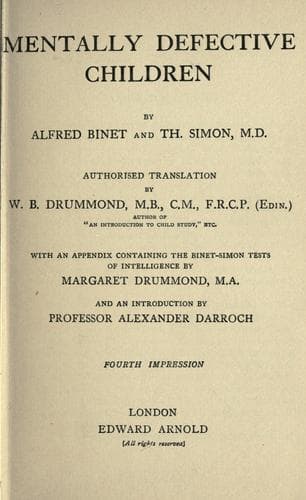
Children with mental disabilities -- Education; Children with mental disabilities -- Psychological testing
From this we may conclude in a general way that it is essential that
the special schools and classes should bring more than half of their
defective pupils to the level of the intermediate course, and improve
more than half of the ill-balanced, if they are to render public
services superior to those of the ordinary schools.
This must be the aim. How are we to know whether it is attained or
not? By supervision exercised in the most serious manner, by well-kept
individual records, in which are noted only facts which can be
controlled.
We remember, a dozen years ago, having turned over the records of
young defectives in an asylum-school which had the reputation of
perfect organisation, a reputation otherwise deserved, for everything
that was shown to the public on visiting days was perfect. But a
distinction must be drawn between what one sees and what one does not
see. The records were kept with surprising negligence. They were dirty
in appearance, torn, disordered, falling to bits. On reading them one
only met with vague estimations, loosely expressed, about children
who, as was repeated to satiety, "would make progress if they would
work better." The less we say the better about contradictory
diagnosis, such as one we noticed on a certificate of discharge:
"Complete idiocy--very much improved"; or the too optimistic
prognosis, really very naïve, if the writer has not had the bad taste
to be ironical: "Vicious child--would make an excellent housemaid." If
documents could be kept in this way, it is quite clear that those who
so kept them felt pretty sure that nobody would ever read them.
We demand that the notes which show the educational progress of the
pupils should be written under the constant fear of control, in order
that they may be guaranteed against negligence and interested
optimism. The manner of control is very simple, and may be summed up
in three paragraphs.
1. The estimation of the progress of the children should be made by
the professors themselves, since they know each child well. The
professor will always keep in mind that his notes will be checked by
the inspector. With regard to instruction, notes will be kept with
regard to reading, writing, arithmetic, spelling, according to the
methods which we have indicated, and such remarks as "good," "very
good," "passable," each signifying absolutely nothing, will be
avoided. With regard to the manual work, it goes without saying that
the record would have to be made in a somewhat different way.
2. The inspector will examine a certain number of cases chosen
haphazard. He must carry out this control with an open mind and
without prejudice.
3. He will make use of methods of control of a strictly impersonal
nature.
Public-domain text, read in full here on John Shaqi.
Reviews
Reviews
No reviews yet
Be the first to share your thoughts on this work.
Elsewhere in the archive
Join the Discussion
Join the discussion
Sign in to leave a comment or review.
Sign InorCreate an account