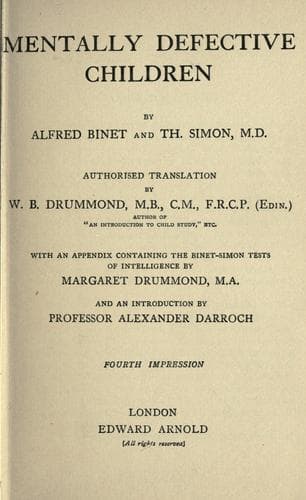
Children with mental disabilities -- Education; Children with mental disabilities -- Psychological testing
Thus, the amount of retardation increases with the years. It is at
first two years, then three, then five. But this augmentation in the
amount of retardation, which is the first fact to strike the
attention, ought not to conceal from us that there is real progress in
the mental condition and in the studies; in fact, we may remark that
if a defective child, in passing from the age of eight to eleven, has
an augmentation of retardation of one year with respect to his
companions, this proves that in the same time he has progressed two
years with respect to himself. It is like an omnibus which goes more
and more slowly, yet advances all the same. To be more precise, let us
say that, since the defectives reach, as an upper limit, the
intermediate course, and that in the proportion of two-thirds, one may
conclude that they make nearly half the progress of the normal
children. Be it understood, this is only roughly true, and many
reservations must be made with regard to details. But the indication
which these documents afford is, nevertheless, very instructive, for
it shows us that the majority, two-thirds at least, of the defectives
appear regularly to duplicate each class, or to take two years to pass
a stage which the normal child passes in one. It is important to
remember this, for the teachers do not always give the facts their
true value. They have a tendency to compare the slow progress of the
defective with the more rapid progress of the normal, and to conclude
from this comparison that the defective remains stationary. This is a
pure illusion, which may be compared to what one experiences when
looking out of the window of a train in motion. One sees another train
going in the same direction but more slowly, and imagines that the
second train is not moving. Let us retain, therefore, provisionally,
the following important idea: _Only half the defectives in an ordinary
school reach with difficulty the intermediate course, first year,
passing through the different stages in double the normal time._ No
doubt one would find many examples of slower progress still, three or
four times the normal. On the other hand, the teacher sometimes points
out a defective who has improved very rapidly, as if his intellect
awoke from a long sleep. Such cases exist, but they are very rare, and
they are open to the suspicion that an error in diagnosis has been
made, and that the child who has improved so greatly was wrongly
considered defective.
With regard to the ill-balanced, the success of the ordinary school is
much greater. A recent inquiry taught us that in the course of two
years half the children noted as ill-balanced were regarded by the
teachers as improved. This figure speaks for itself.
Public-domain text, read in full here on John Shaqi.
Reviews
Reviews
No reviews yet
Be the first to share your thoughts on this work.
Elsewhere in the archive
Join the Discussion
Join the discussion
Sign in to leave a comment or review.
Sign InorCreate an account