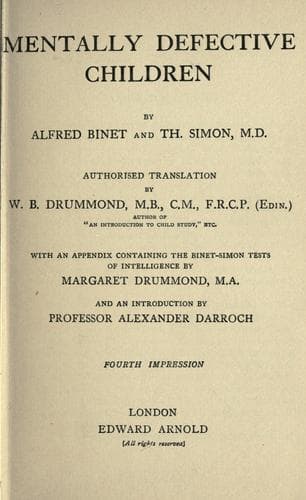
Children with mental disabilities -- Education; Children with mental disabilities -- Psychological testing
It is hoped that the publication in translation of the work of Binet
and Simon in which these tests first appeared, along with the complete
series of tests as extended and revised during the lifetime of the
former, will tend to remove this twofold misapprehension, and make the
educationalist, as well as the wider public interested in social
questions, acquainted with the real purpose which underlay the devisal
or invention of the tests, and so enable all to perceive that their
relative value, as measuring stages of intelligence, must be judged by
the purpose for which they were devised.
Now, the main purpose of the authors in the devisal of these tests is
to furnish to the teacher a _first_ means by which he may single out
mentally backward children, who, upon further examination, may also be
found to have some mental defect or peculiarity which prevents them
from fully profiting by the education of the ordinary school, and who
probably would benefit more by being educated in a special school or
in a special class. But the final selection, it is contended, of
defective children for special education demands the experience of the
doctor and of the psychologist, as well as the knowledge of the
teacher, and the aid of all three is necessary in the devisal of
courses of study for the mentally defective. Especially important is
the division of mentally defectives into two main classes--the
feeble-minded and the ill-balanced. The latter, as a rule, are easily
marked out from the normal child, and, if not specially looked after,
may in later life become a menace to society. The feeble-minded, on
the other hand, may easily escape the notice of the teacher, and may
pass through the ordinary school unaffected and unimproved, enter into
society, and propagate their kind. Both classes require the special
care of the community, and their proper education and training are of
the gravest importance for the welfare and stability of society. In
this selection and education of mentally defective children, three
positions of Billet and Simon are worthy of consideration. In the
first place, it is contended that a physical examination alone can
never allow us to dispense with a direct examination of the
intelligence, and that "anthropometry, stigmata, and physical
appearance must take a second place as means of discovering in school
the feeble-minded and the ill-balanced." Again, "mental deficiency and
want of balance are peculiar mental conditions which it is often
impossible to connect with definite pathological changes." Hence the
examination of the medical man is not decisive. It must be
accompanied and reinforced by that of the psychologist. In the second
place, it is affirmed that in the devisal of schemes of training for
mental defectives, we must take into account that the dominant
features in their life are the "senses, the concrete perceptions, and
motor ability," and that "in the education of defectives the workshop
Public-domain text, read in full here on John Shaqi.
Reviews
Reviews
No reviews yet
Be the first to share your thoughts on this work.
Join the Discussion
Join the discussion
Sign in to leave a comment or review.
Sign InorCreate an account