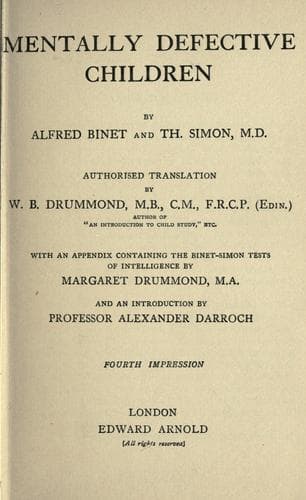
Children with mental disabilities -- Education; Children with mental disabilities -- Psychological testing
sets them against anything abstract, and one would do them a very
poor service by depriving the more intelligent of them of the ordinary
curriculum, and all the more as the majority of the ill-balanced are
destined to improve considerably. Thus there are many reasons why, in
the case of certain classes of the abnormal, one should not lose sight
of the usual curriculum. These reasons are as follows: the slight
degree of the deficiency in certain cases, or the existence of
instability without retardation, or the necessity of sending the
children who improve most back to the ordinary schools. Such are the
reasons which are important from the school point of view. There are
others with a social bearing which are more important still. At the
present day it is necessary, especially in towns, that everyone should
be able to read, to write, and to express himself in suitable
language. It has been remarked, and justly, that reading is the
triumph of abstraction, and that a defective may require two years to
learn to read by syllables, and very poorly even then. No matter: if
the thing is possible, even with considerable effort, such a defective
ought to learn to read. This is demanded, not by the state of the
child's intelligence, but by the society in which he lives, where
illiteracy would bring shame upon him. In questions of this kind the
indications of psychology and pedagogy should be subordinated to the
needs of life. Necessity makes the law. All instruction given to
defectives must be dominated by the question of its practical
usefulness. A pedagogy which should be fitted easily to the measure of
their intelligence would be dangerous, in that it might result in
making them useless. It is evident, therefore, that the problem is
very complex, and it would be quite useless to attempt to express it
by a single formula. The nature of each individual case must be taken
into account, and one must aim at an essentially practical training, a
pedagogy of ends rather than of abstract principles. Our advice,
consequently, is that in the meantime no definite curriculum should be
fixed upon, but that the teachers of defective children should be
allowed some freedom, under the cautious control of the primary school
inspectors. We ask that all intelligent initiative should be accepted
and encouraged, and that the teachers in special schools should
frequently meet together in order that they may compare their
experience. In short, we should give to the schools and classes for
defectives such freedom and elasticity that the kind of education best
adapted for such children would be able to evolve and perfect itself
like a living organism.
FOOTNOTES:
[2] On the other hand, Dr. Abadie found 309 defective to 134
ill-balanced.
[3] At the _Laboratoire de Pedagogie Normal_, 36, Rue
Grange-aux-Belles. For details of the work of this laboratory see
_Année Psychologique_, tome xiii., pp. 1, 233.
Public-domain text, read in full here on John Shaqi.
Reviews
Reviews
No reviews yet
Be the first to share your thoughts on this work.
Join the Discussion
Join the discussion
Sign in to leave a comment or review.
Sign InorCreate an account