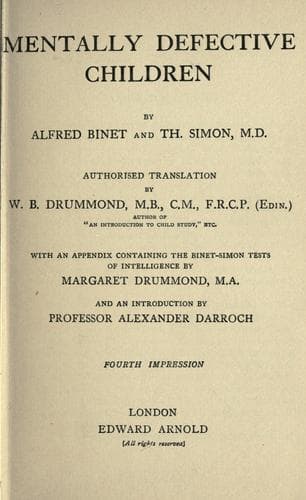
Children with mental disabilities -- Education; Children with mental disabilities -- Psychological testing
=A retardation of three years indicates a child who should be regarded
as a suspect.= A child enters the elementary school at the age of
about six years. Each year he ought to advance one class. From six to
nine years he is in the elementary course; from nine to eleven in the
intermediate course; from eleven to thirteen in the senior course. All
are not quite regular. Some are a little in advance, some are behind,
but the majority conform to the preceding scheme. When a school is
well managed, when the assignation of the children to their respective
classes is made by means of suitable tests, and without too great
regard to the demands of the parents, the classification which results
is very good. There is then no better means of finding out whether a
child is intelligent or not than to take into consideration his age
and his class. Intelligence, so extraordinarily difficult to judge, is
indicated in the above way with a really curious exactness. A child
two years behind his age, when irregularities in attendance, absence
on account of illness, etc., do not explain his backwardness, is very
likely to be less intelligent than one who is in, or in advance of,
the usual class for his age. This amounts to judging intelligence by
the degree of instruction. Theoretically, such a method is open to
plenty of meticulous objections, of which the most important is that
we are confounding intelligence and memory. To this we shall reply
that the stage of instruction reached is not the result of memory
alone. It presupposes also some degree of application, some facility
of comprehension, quite a collection of diverse aptitudes. The child's
success in his studies is, in fact, the best indication we have of his
capacity to adapt himself to the school environment. If the child is
unable to keep up with the classes suited to his age, if he is unable
to profit like other children from the education provided, this shows
that he has not the same degree or the same kind of intelligence as
his companions, and there is a presumption, if not an absolute
demonstration, that his intelligence is inferior to the average, or
that his character is different.
From these statements, which we have expounded at length elsewhere,[6]
it follows that not only the head-master, but an entire stranger, can
determine which are the less intelligent children, the less well
adapted to that school, without taking the trouble to interrogate them
all individually. It is only necessary to compare their position in
school with their age.
Public-domain text, read in full here on John Shaqi.
Reviews
Reviews
No reviews yet
Be the first to share your thoughts on this work.
Join the Discussion
Join the discussion
Sign in to leave a comment or review.
Sign InorCreate an account