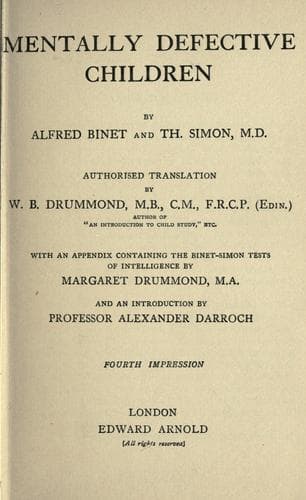
Children with mental disabilities -- Education; Children with mental disabilities -- Psychological testing
This selection will be good, without being final. It will be good, for
it is based upon a wide experience extending over several years. Just
think what it means in the way of inattention and want of
comprehension if a child is three years behind. For our own part, we
consider this evidence from experience of the greatest value. It is
the obvious point of departure. We can and should try to interpret it
and to complete it, but we are not justified in taking no account of
it. Let us even say boldly that if, by some unhappy chance, other
finer methods should conflict with this, and indicate as defective a
child who has shown himself well adapted to school life, it is school
life which should be considered the more important test. How, indeed,
could one call a child defective who succeeds in his studies and
profits by the instruction in the normal way? Thus we sum up by
remarking that _we possess a very simple method which enables us to
recognise all the children whom we have any right to suspect of mental
deficiency_. _This method consists in taking account of the
retardation of the children in their studies._
* * * * *
For the recognition of the ill-balanced children the rule is the same.
The head-master must pick out those children whose undisciplined
character has kept them from submitting to the ordinary school régime,
and has made them a continual source of disturbance. Whilst the
simply defective fail to adapt themselves to school life by reason of
their mental deficiency, the ill-balanced fail owing to their
inco-ordination of character. In the second case, as in the first,
there is a similar defect of adaptation, and the best proof that this
defect is present in a particular child is the continued evidence of
several years, the testimony of different masters, who declare that,
with the best will in the world, they cannot break in the recalcitrant
child to rule. But it must be recognised that the appreciation of want
of balance is more delicate, more subjective, than that of
retardation. The latter is indicated by a definite incontrovertible
fact--the insufficiency of instruction. On the other hand, lack of
balance has only a slight effect on a child's intelligence and his
success in his studies. It is indicated to outsiders especially by the
complaints of the masters. And the latter, to tell the truth, may be
led to exaggerate a little, especially if they see a means thereby of
ridding themselves of children with whom they have not much sympathy.
We shall see in a little, when we speak of the rôle of the inspector,
how the latter must check the statements of the head-masters.
Public-domain text, read in full here on John Shaqi.
Reviews
Reviews
No reviews yet
Be the first to share your thoughts on this work.
Join the Discussion
Join the discussion
Sign in to leave a comment or review.
Sign InorCreate an account