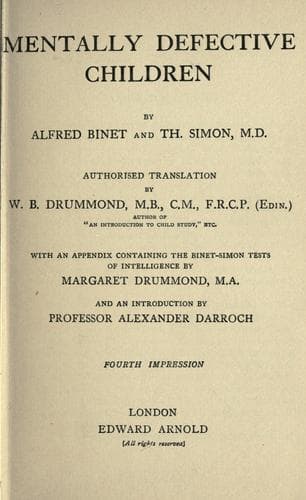
Children with mental disabilities -- Education; Children with mental disabilities -- Psychological testing
The number of children suspected of mental deficiency obtained by this
method varies extremely from one school to another, independently of
the mistakes which are made by the head-masters with lamentable
frequency. We have found the proportions varying from 0.2 to 10 per
cent., with all the intermediates represented. The average of suspects
for ten girls' schools, with an average of 300 pupils, was 3.7 per
cent.; for eight boys' schools in the same district, and strictly
comparable to the preceding, it was 5.35 per cent. It must be clearly
understood that these figures are provisional. They do not correspond
to real defectives, but to children _suspected_ of mental deficiency;
and, moreover, they do not include the unstable, unless they are also
defective.
Having made these deductions, one writes to the head-masters, or
perhaps summons them to a meeting, in order to ascertain the names of
these children and various other particulars.
These particulars will refer to three main points:
1. Give the full names and date of birth of the backward children (by
two or three years, according to the distinctions given above), and
indicate also whether the retardation is explained by irregular
attendance, by want of application, or defective intelligence.
2. Indicate the children who, although they do not belong to the
preceding category, yet appear to be distinctly abnormal.
3. Indicate also the children who are ill-balanced and rebellious to
all discipline in the opinion of several teachers who have had them in
their classes.
We have already received replies which seem to us instructive, and
even carry us beyond the study of the abnormal, as they may throw some
light on the psychology of those who are commonly called "dunces." As
a general rule, the children classed as retarded are the victims of
disease, constitutional debility, or malnutrition. We find included in
our lists some who are the children of nomadic parents; some who have
been kept from school; some who have attended a religious school,
where they learned little but sewing and writing; some who have
changed their school too often; some also who are foreigners, and
understand little French; and, lastly, some who have been kept back in
their studies by unrecognised myopia. Such causes are extrinsic to the
child. The personal causes of retardation are defective intelligence,
sluggishness of mind, insubordination, an eccentric and excitable
nature, a constant want of attention, and, lastly, laziness.
Public-domain text, read in full here on John Shaqi.
Reviews
Reviews
No reviews yet
Be the first to share your thoughts on this work.
Join the Discussion
Join the discussion
Sign in to leave a comment or review.
Sign InorCreate an account