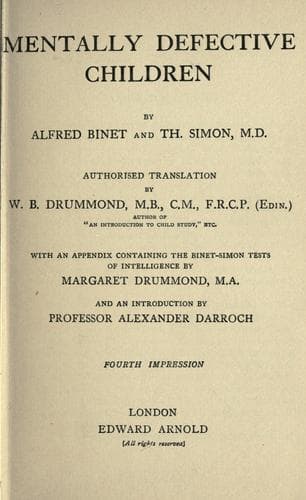
Children with mental disabilities -- Education; Children with mental disabilities -- Psychological testing
Work is better done when it is subject to inspection. The head-masters
will take more care in the selection of the defectives if they know
that all their cases will be examined by a person whose competence is
equal to their own, and whose position is higher. The inspector, who
is generally well acquainted with his personnel, will see at a glance
what he ought to think of the returns which are furnished to him. He
knows that one master is too severe, and another too indulgent. He has
to restrain the overzealous, to stimulate the indifferent, and
encourage the despondent. When it is a question of estimating a
child's want of balance, it is necessary to know the character of the
judge. Some good teachers fail to gain the necessary ascendancy over
one of their pupils, either because they are indulgent where
strictness is necessary, or because by excessive brusqueness and
severity they alienate natures which require to be humoured. The
inspector will succeed in taking all these things into account. He
will interpret correctly the facts which are laid before him, because
it is his business, his _métier_.
=Significance of Irregular Attendance.=--The inspector will begin, let
us suppose, by examining the returns given concerning the backward
children. From the notes sent to him he will be able to distinguish
between the children whose backwardness is due to irregular attendance
and those who may justly be suspected of mental deficiency or want of
balance. He will thus make a first selection.
Here are some examples of the notes referred to:
_Renné G----_, age thirteen years, is in the intermediate
course, second year; she is therefore three years behind for her
age. The explanation given by the teacher is as follows: "Had
contagious ophthalmia; not admitted to school till ten.
Intelligence middling." If the return is correct, one is not
surprised that the child has not made more progress.
_Suzanne M----_, age twelve and a half years (two years behind);
always very delicate and frequently absent; of average
intelligence.
_Yvonne D----_, age ten and a half years (two years behind);
lived a long time on a boat without going to school;
intelligence average; very industrious.
_Eugenie V----_, age eleven and a half years (three years
behind); educated at a convent school until October last;
intelligence little developed; slow of comprehension; writes and
sews pretty well; spelling poor.
_Suzanne B----_, age eleven and a half years (two years behind);
an intelligent and industrious child, who has travelled much
with her parents, and afterwards stayed in a little
boarding-house. At school since October; she has made great
progress.
_Anna E----_, age eleven and a half years (two years behind);
born in German Switzerland, brought up in England, and has been
in Paris only a year and a half.
Public-domain text, read in full here on John Shaqi.
Reviews
Reviews
No reviews yet
Be the first to share your thoughts on this work.
Join the Discussion
Join the discussion
Sign in to leave a comment or review.
Sign InorCreate an account