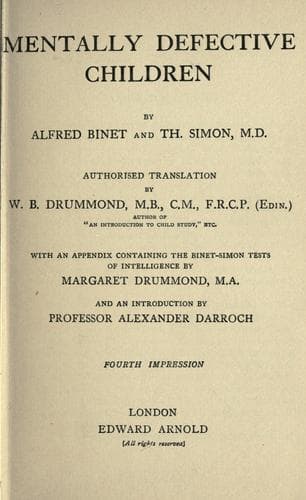
Children with mental disabilities -- Education; Children with mental disabilities -- Psychological testing
A child is presented to the inspector, for example, as belonging to
the intermediate course, first year. Is this correct? It may be that
the child is at the foot of the class, or is even incapable of
following the lessons. Thus, it may be that his class gives a very
poor indication of his capacity. There are plenty of cases where the
head-master, in order to please the parents, puts a child in a class
too high for him. A rapid examination will suffice to test the
grading. This testing is absolutely necessary, and presents no
difficulty to the inspectors. They have the fortnightly report brought
to them, examine the pupil's marks and his exercises, whereby they
form a first impression. It is then necessary to ask some questions,
and on this point we have something to say with respect to method.
There are two ways in which the degree of instruction may be tested.
There is what we may call the _casual method_, which consists in
putting the first questions that come into the mind; and there is the
_systematic method_, which consists in putting questions arranged in
advance, whose difficulty is known, and for which we have a scale (p.
54), which shows the average number of errors to be expected from
normal children of each age. The latter method takes no longer than
the former, and is even easier, because it makes no demand on the
imagination. Moreover, we consider it quite indispensable for fixing
in an objective manner the degree of instruction of the defectives on
the day of their admission to the special school. It is very important
that this degree of instruction should be definitely known, because it
will be necessary to refer to it every time one wants to find out to
what extent the child is profiting by the special instruction. We
shall return to this point in our concluding chapter.
Public-domain text, read in full here on John Shaqi.
Reviews
Reviews
No reviews yet
Be the first to share your thoughts on this work.
Join the Discussion
Join the discussion
Sign in to leave a comment or review.
Sign InorCreate an account