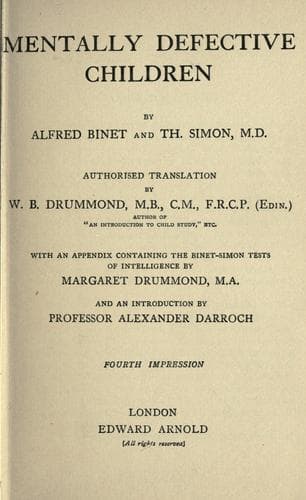
Children with mental disabilities -- Education; Children with mental disabilities -- Psychological testing
Here is a child of nine years of age, who has been selected for a
class for defectives because he cannot follow the usual lessons in the
elementary school. You, however, doctor, put to him some of your usual
questions. You ask the child his name, his age, the occupation and
address of his parents; the date, day, month, year; some details about
his life; you even ask him to read or count. The replies are given to
you quietly and correctly. Are you going to refuse to admit him to the
special school, and by what right? You have the notes of one, of two,
or of three teachers. He cannot follow; he is still with children of
seven years of age, in spite of having been at school for three years.
It is evident that he is not an idiot, nor an imbecile, nor even
feeble-minded to any great extent. But you have been notified that he
is behind other children of his age. There is therefore something
peculiar about him. It is not a medical question whether he ought to
remain in the ordinary school. The doctor cannot go against the
opinions which have been given to him, in order to verify whether the
retardation is genuine. To do so, it would be necessary for him to
make a comparison with the normal condition. Now this varies according
to age. The doctor does not know exactly, to two or three years, the
normal condition of the mental faculties; nor, after such and such a
period of school attendance, the habitual level of instruction
reached. That, however, in such special conditions, is the very
problem which faces him. We do not hesitate to express the opinion
that, in such circumstances, the doctor would be incapable of
estimating the intellectual level of the child. He has no more
experience in this matter than any other person. Let a doctor seek to
pick out a feeble-minded child from a number of normal ones, and he
will find how little he is prepared to make the selection.
=Physical Examination of Defectives.=--But it may be asked: "Is not
mental debility associated with physical signs which the doctor alone
is able to appreciate?" About this question three kinds of facts may
be considered: those pertaining to anthropometry, the stigmata of
degeneration, and physiognomy. Let us consider in order what help may
be derived from these.
Public-domain text, read in full here on John Shaqi.
Reviews
Reviews
No reviews yet
Be the first to share your thoughts on this work.
Elsewhere in the archive
Join the Discussion
Join the discussion
Sign in to leave a comment or review.
Sign InorCreate an account