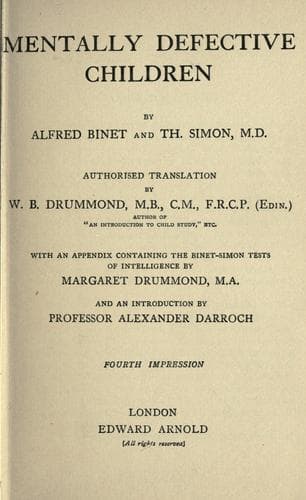
Children with mental disabilities -- Education; Children with mental disabilities -- Psychological testing
Why, there remain just the very children with whom the new law will be
concerned. In the meantime these are not in any special school; they
are attending the primary schools, which cannot shut the door in their
faces when they have arrived at school age. But they do not profit
much by the instruction given in school, and this fact gives rise to
vigorous complaints on the part of the teachers. These children, say
they, are not in the least like the great majority of other pupils. A
great many of them are mentally defective. Without being completely
lacking in intelligence, they are not sufficiently endowed therewith
to work alongside normal children; they do not understand, they cannot
follow; they profit so little by attending the school that some of
them are never able to assimilate the instruction even of the
elementary course. Very often they pay no attention whatever to the
work of the class; and this is quite a good thing, for then the
teacher forgets them in their corner, and goes on as if they were not
there. But many of these children are ill-balanced; they are
excitable, and their bodies are never at rest; they are not amenable
to ordinary discipline. They are a constant source of trouble and
annoyance to their master and to their comrades. The supervision of a
single ill-balanced child is more trouble, the teachers sometimes
declare, than the direction of twenty normal ones. Either one or the
other must be neglected, and the alternatives are equally
objectionable.
What, then, must be done with those children who are not amenable to
the ordinary school discipline? At first sight this seems a simple
question. Let them be sent to an institution. We actually possess in
the hospitals of Bicêtre and of the Salpêtrière, in the colony of
Vaucluse--to say nothing of provincial institutions--establishments
which make provision, both medical and educational, for children who
are idiotic, imbecile, vicious, and epileptic. Is it not possible to
send to these institutions all the abnormal children who encumber the
primary schools?
No; it is neither possible nor desirable to pack them off to an
asylum. These abnormal children are not in all cases so severely
affected as to require segregation. We admit that such a measure is
necessary for idiots of low grade who cannot even feed themselves. We
have also no objection to leaving to the asylums cases of very severe
nervous disturbance such as epilepsy, for only there can they receive
the medical supervision appropriate to their condition. They have more
need of the doctor than of the teacher. As for the other abnormal
children who constitute the great majority, it seems clear that the
proper place for them is not the asylum, but the special school. They
have sufficient intelligence to attend a school. What they probably
require is instruction specially adapted to their mental state, and
such instruction can be profitably given only in classes small enough
to permit of individual attention.
Public-domain text, read in full here on John Shaqi.
Reviews
Reviews
No reviews yet
Be the first to share your thoughts on this work.
Join the Discussion
Join the discussion
Sign in to leave a comment or review.
Sign InorCreate an account