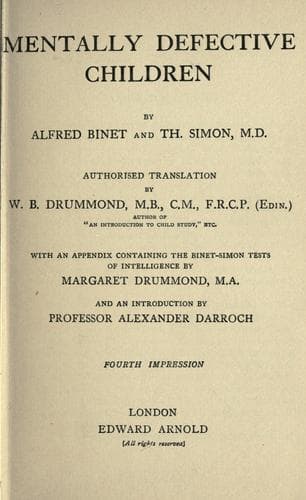
Children with mental disabilities -- Education; Children with mental disabilities -- Psychological testing
What, then, are the first problems to be solved? Let us consider just
exactly where we are in the examination. Here are the children picked
out by the teachers. The inspectors themselves have checked the
selection and referred back some of those selected, but very few, if
they have carefully directed the methods of choice from the beginning.
The children presented are backward in their studies. Inquiries
regarding their school attendance have shown that the retardation is
not due to irregular attendance. The examination of their intelligence
has confirmed this judgment.
It still remains to discover whether, amongst all these children who
are unable to follow the ordinary school curriculum, there do not
exist some who are not, properly speaking, mentally deficient, but who
are suffering from some illness. May we not find amongst them some
who require medical treatment rather than special teaching--_e.g._,
cretins? And, lastly, may there not be some children whose mental
deficiency complicates some other disease, such as epilepsy? These are
problems which are essentially medical, and which it is necessary to
solve before admitting a child to a special school. Let us consider
them in order.
=1. Is the Case one of Mental Deficiency, or of an Intercurrent Mental
Affection?=--To tell the truth, there is not often any doubt. However,
there are two circumstances in which doubt may arise. In the first
place, an arrest in a child's mental development may be the expression
of a state of depression which indicates a psychosis in the course of
evolution, or it may be the first sign of decadence in one of those
degenerates of whom Morel speaks, who seem to have "a limited mental
existence." Such cases, which some authors describe under the name of
"dementia precox," require a medical regimen.
In the second place, it is possible that the etiological factor is
alcohol. Alcoholism in the parents is frequently the cause of mental
deficiency. But the effects of drinking do not always stop there. The
child itself may be made to drink, and consequently the doctor may
sometimes find symptoms resulting from direct intoxication--nightmares,
or tremor of the hands. Such intoxication may be responsible partly, if
not entirely, for the want of progress at school, and also for the
irritable temper which the child shows in class. It would be necessary
in such cases to see the parents, and to advise a different hygiene for
their child at any rate, if they themselves cannot be persuaded to give
up their bad habits. In this way one may be able to avoid sending the
child to a school for defectives. It is apparent that even if the child
were sent to such a school, it would be necessary to put a stop to the
administration of alcohol. The rarity of such cases makes their
exposition of almost theoretical interest.
Public-domain text, read in full here on John Shaqi.
Reviews
Reviews
No reviews yet
Be the first to share your thoughts on this work.
Elsewhere in the archive
Join the Discussion
Join the discussion
Sign in to leave a comment or review.
Sign InorCreate an account