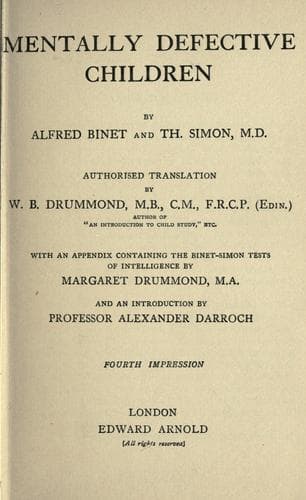
Children with mental disabilities -- Education; Children with mental disabilities -- Psychological testing
=2. Would the Mental Deficiency respond to Medical Treatment?=--Cannot
the doctor prescribe something to cure the mental deficiency or want
of balance? Let us give some consideration to this question. Medicines
act either upon the symptoms of a disease, or upon the organic changes
which produce them, or, lastly, upon the very causes of such organic
changes. Quinine, for example, has a selective action on the parasites
of malaria; mercury produces an undoubted effect upon syphilitic
growths; treatment by cold baths keeps the temperature of typhoid
fever below a certain level during the whole of the illness. Cannot
analogous results be hoped for in mental deficiency? A brief résumé of
what we know concerning the causes of mental deficiency and the
anatomical lesions which accompany it will determine our answer.
The dominant etiological feature is that mental deficiency and want of
balance depend upon hereditary conditions, or conditions acquired in
the earliest stages of development. By hereditary conditions must be
understood strictly those which result from alterations in the germ
cells of the parents. An intoxication alone seems capable of
exercising upon the latter a sufficiently general action to reach the
germ cells, and by far the most frequent poison is alcohol. By
acquired conditions must be understood the results of diseases of the
foetus or of infancy, and especially the cerebral complications of the
infectious fevers--_e.g._, meningitis in the course of an eruptive
fever. In all such cases, with rare exceptions to be mentioned
immediately, by the time the mental deficiency is discovered, its
causes are no longer active, and consequently cannot be affected by
medical intervention.
The statements we have just made with regard to the causes of mental
deficiency lead to some practical conclusions. The ultimate evolution
of the congenital cases differs from that of acquired cases, and this
renders a study of the early history of the child important. If the
development of the child has been normal at first, and has then been
abruptly interrupted, for example, by an attack of meningitis, of
which we can obtain by inquiry a definite history, the prognosis is
not good. For it is a well-recognised fact that cases of acquired
mental deficiency are not likely to make a fresh start. If we were
hesitating whether to send an imbecile child to an asylum or to put
him in a class for mental defectives, a history like the above would
lead us to give the preference to the asylum; but let us say once
more, we do not find here an indication for treatment.
As to the changes which are found post-mortem, these are manifold and
of an unalterable kind. They are as follows:
Public-domain text, read in full here on John Shaqi.
Reviews
Reviews
No reviews yet
Be the first to share your thoughts on this work.
Elsewhere in the archive
Join the Discussion
Join the discussion
Sign in to leave a comment or review.
Sign InorCreate an account