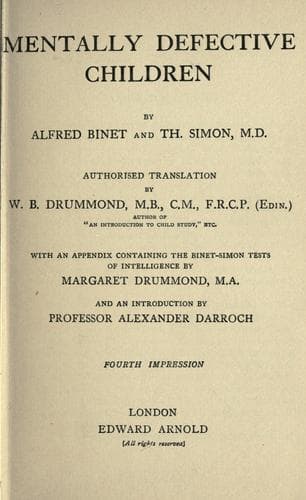
Children with mental disabilities -- Education; Children with mental disabilities -- Psychological testing
And yet this is not all. A few days or a few hours before such
symptoms occur, or immediately after them, or, lastly, according to
some authorities, entirely independently of them, the patient may
develop a peculiar condition of irritability, in which he will
transgress against discipline, make insolent remarks, or even give way
to violence. Such actions ought not to be suppressed by punishment,
because they are of morbid origin.
All such symptoms possess this characteristic, that they leave no
trace on the memory of the child. He himself knows nothing about them,
or knows them only by what he has heard from other people. There can
now be no need to insist with what care inquiries must be made,
especially of the parents.
Are epileptics to be admitted into the special class? On principle
they are refused admission to the ordinary school. They are, however,
to be found there. There are those whose attacks occur very rarely, or
are so slight as to cause no disturbance. There are probably also
unrecognised cases of epilepsy in which the symptoms occur during the
night, or on awakening, but never in class. Only the severe forms are
turned away. Probably the same state of affairs will recur in the
classes for the abnormal--at any rate until the time when provision
for epileptics is more extensive than it is at present. It will
therefore be necessary to recognise these cases, to supervise them
with special care during certain kinds of manual work, and, if
possible, to treat the nervous symptoms suitably while the patients
are receiving instruction.
_Hysteria._--Although hysteria has not the same gravity, it is no less
advisable that cases should be tracked out. This neurosis is being
discussed to-day as never before. Without setting forth at length what
we think should be included under this term, let us point out a
characteristic of hysteria which is commonly recognised, and which is
of such importance that it indicates the line of treatment to be
followed. The two principal manifestations of the affection,
hysterical fits and the recital of lying tales, require for their
complete development the presence of a public, of a gallery.
Inversely, their disappearance is assured by isolation or apparent
inattention.
The discovery of such tendencies before entrance to the school will
allow the doctor to forewarn the teacher, and point out to him the
best way of dealing with such children.
* * * * *
There are still three affections about which we must say a few
words--rickets, adenoid vegetations, and scrofula.
Public-domain text, read in full here on John Shaqi.
Reviews
Reviews
No reviews yet
Be the first to share your thoughts on this work.
Elsewhere in the archive
Join the Discussion
Join the discussion
Sign in to leave a comment or review.
Sign InorCreate an account