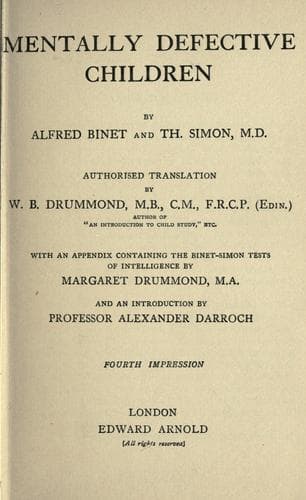
Children with mental disabilities -- Education; Children with mental disabilities -- Psychological testing
_Epilepsy._--Epilepsy frequently coexists with mental deficiency. Now,
epilepsy does not always reveal itself by severe fits with crying,
falling down, loss of consciousness, convulsions, stiffness followed
by jerking of the limbs, foaming at the mouth, biting of the tongue,
and involuntary passage of urine. It is revealed also by symptoms of a
less striking nature, which have been described under the name of
_petit mal_. Such are loss of consciousness, vertigo, or simply mental
perturbations. Loss of consciousness occurs without the tremor of a
muscle, the child suddenly turns pale, loses consciousness for a
moment, and then continues whatever he was doing--for example, walking
or writing. There is nothing more impressive to notice when the fit
occurs as one is talking to the little patient. One sees, as it were,
the passing of a veil. But nothing could be more fugitive, nothing
could more easily escape the notice of anyone who was not a good
observer. Often the parents know nothing about it. The attacks are so
short, the consequences apparently so slight, that even if the parents
have chanced to notice them, they do not always think of mentioning
the fact. The teacher of defective children ought to be instructed in
the characteristics of this affection. He is going to spend several
hours daily with the children. He will have the best opportunities for
noticing the occurrence of attacks, which may be rare, but which, when
they occur, are very significant.
Although the symptoms are a little more marked, vertigo also is of
brief duration. To the pallor and the loss of consciousness of the
preceding condition there is added a little muscular relaxation. The
child totters, supports himself by anything in his neighbourhood,
slips down in his seat, or drops his pen. Sometimes there is a slight
spasm of the muscles of the face, the mouth is drawn to one side by
slight jerks, or performs some movements of mastication or
deglutition. And that is all--no convulsions of the limbs, no passage
of urine, scarcely an interruption to the work which is being done.
Whether the doctor discovers these symptoms by interrogation of the
parents, or whether the teacher some time afterwards describes them
to him with sufficient detail to permit of a certain diagnosis, a
double gain results. In the first place, there is an indication for
treatment; and in the second, the possibility of supervision. As a
matter of fact, it too frequently happens that these symptoms, little
dramatic as they are, reveal the existence of epilepsy, which will
ultimately result in progressive mental decadence.
Public-domain text, read in full here on John Shaqi.
Reviews
Reviews
No reviews yet
Be the first to share your thoughts on this work.
Elsewhere in the archive
Join the Discussion
Join the discussion
Sign in to leave a comment or review.
Sign InorCreate an account