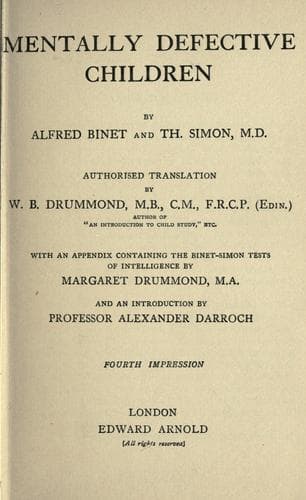
Children with mental disabilities -- Education; Children with mental disabilities -- Psychological testing
=An Inquiry in the Hospitals.=--Two years ago one of us betook himself
to M. X., an important official in one of our ministries, in order to
ask him to join a Ministerial Commission which was going to pay a
visit to one of our asylum-schools. M. X. shrugged his shoulders, and
replied energetically: "No, no, no! I have had enough of such visits.
I will go neither to the Salpêtrière nor to Bicêtre. What would I see
there? An idiot who allows his saliva to collect in his open mouth;
another who has epileptic fits; a third who can say nothing but 'Ba,
ba!' What would that prove? The only way in which one can find out
whether a school for bad cases of mental deficiency is good for
anything, is to find out the mental condition of those who leave. How
many defective subjects are there who, after having been treated at
the Salpêtrière or at Bicêtre, are able to gain their own livelihood?
That is what one would like to know, and that is what no one ever
tells us!"
The listener to these incisive and sensible remarks replied, after a
moment's reflection: "I entirely agree with you. The information which
you desire is of the greatest importance for judging the value of a
school. I imagine that such information would be difficult to obtain.
But one can try. I am willing to make the attempt."
A few days later the two authors of the present work took the field.
The long preliminary conversations which they had had together about
this subject had convinced them that they would encounter opposition.
But they decided to treat the question as one treats a scientific
matter--with perseverance, with courage, and without _parti pris_ of
any kind.
Let us subdivide the question to make it more plain. We proposed to
discover the value of a school. To make such an inquiry really
complete, it would be necessary to consider the question from two
points of view--the one educational, the other social.
The educational return consists in the degree of instruction which the
institution succeeds in giving to its pupils, after so much time, and
with so much expense. In the case of an institution for the sick, the
return will take the medical form of a cure or improvement of health.
In order to estimate such various returns, it would evidently be
necessary to be in possession of various data: (1) A knowledge of the
state of instruction or the state of health of the subjects on their
admission to the school; (2) a knowledge of their state of instruction
or of health on leaving, so that one would be able to estimate by
comparison what they owe to the school; (3) a knowledge of the cost
for each pupil, whether for instruction or for medical expenses.
Public-domain text, read in full here on John Shaqi.
Reviews
Reviews
No reviews yet
Be the first to share your thoughts on this work.
Elsewhere in the archive
Join the Discussion
Join the discussion
Sign in to leave a comment or review.
Sign InorCreate an account